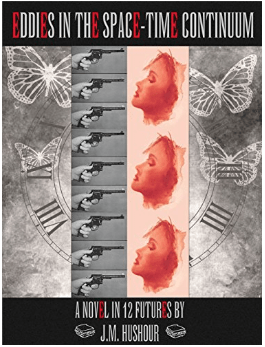
New Book Review 41: Eddies in the Space-Time Continuum

eddiesThe next book I’m reviewing here is Eddies in the Space-Time Continuum by J.M. Hushour, a thoroughly unconventional comedic sci-fi novel. This is going to be a longer review than the others, because there is a lot to say about this work. I downloaded the ebook over two years ago and discovered three things: one, the writing is phenomenal; two, the book does not exist in print; and three, the book would be over a thousand pages long if it did exist in print. I don’t enjoy reading ebooks as much as I enjoy reading print books (I know, it’s 2018, sue me) and this book’s improbable length added to that issue, but the writing was so good that I wasn’t willing to give up on it. So, I tried and retried this book a couple of times before I finally got a running start at it and spent a month reading through the whole darn thing. It was most definitely worth the read, but likewise reading it was a real chore.

The novel consists of twelve chapters. Each chapter (with one exception) takes place on March 30, 2050, the birthday of our protagonist, Eddie. As we gradually learn, Eddie has a condition similar to that of Bill Murray’s character in Groundhog Day or Tom Cruise’s character in Edge of Tomorrow. He is constantly reliving the same day. In this author’s interpretation of the theme, each repeated day that Eddie experiences is in a different version of the future. Humanity just keeps on finding new ways to make itself miserable, and Eddie is witness to every one of them. Doom by rising sea levels. Doom by corporatocracy. Doom by plague. There is always some monstrous crisis coming to a head on Eddie’s birthday.

In every version of the future, Eddie is a physically imposing but gentle-hearted creative type, fairly befuddled by his place and time. He owes some inspiration to Douglas Adam’s baffled protagonist Arthur Dent (and, the book’s title is itself a reference to The Hitchhiker’s Guide to the Galaxy). Eddie is inevitably and hopelessly in love with Viola, a Scottish woman who in every version of the future is some kind of outsider radical extremist, in her own mind fighting to free the world from its present crisis. Though their first meeting in the first version of the future was filled with quite a lot of hostility, every subsequent future brings them closer and closer together, with Eddie becoming braver and stronger in each repetition, and with cycles of déjà vu and shared recurring symbols—an enigmatic sandwich, the Shakespeare play Twelfth Night, butterflies—revealing to Eddie and Viola that they have met each other over and over again in different versions of their reality. Binding all of these realities together is the mystical notion of the qutb, something like the axis of a wheel, a notion taken from Islam and explored in this work. Also in each reality appear a cast of characters whose fates are bound with those of Eddie and Viola. To name a few key players: Hijack, Eddie’s sometimes-male-sometimes-female sibling who is a sort of drug dealer Willy Wonka; Aivia, a woman who is inevitably in the process of using science to change into a bird; Hélolard, sometimes a therapist, sometimes a cyborg stripper, sometimes a military commander, usually a mentor, always taking command over Eddie; and, crucially, the antagonist, a mysterious entity called the Queen of Hurts, who is always appearing to tear down reality. If I haven’t made this clear yet, it’s all a lot to take in.

One of the reasons this book impressed me from the very beginning was its intense, colorful use of language as a vehicle for ideas, delivering metaphors and zingers and philosophical notions in every sentence, keeping the scene interesting even when little was happening. It reminded me a lot of the books I’ve read by Tom Robbins (and, I saw that this author listed Tom Robbins as an influence). The book is very funny from the very beginning, funny in a Douglas Adam kind of way, but as it goes on and the nature of the book’s central threat becomes clearer, the tone becomes much more serious.  The change happens slowly, so much that you might not notice it happening unless you get a ways into the book and begin comparing one chapter to another. With all this business of multiple realities and multiple speculations about the future, sometimes the book got very confusing. There were times when the events on the page really didn’t make a lick of sense. But, I was so impressed by the work as a whole that this didn’t bother me at all.

Readers should be aware that this is a book for adults, with quite a lot of violence and sex and coarse language and coarse themes and so on. Some readers are put off by that. As for me, I was blown away. I really wish this book existed in print, because I want it on my shelf. I want to be able to flip through physical paper pages of it and enjoy it that way, because it is a masterpiece. I would highly recommend it to a wide variety of readers: fans of science fiction, fans of comedy, fans of absurdism and surrealism, readers looking for new and original ideas, etc. This book seems to be pretty obscure right now, but I don’t think it should be. I think a really wide audience would and should appreciate this book as much as I have.

And now, as I always do in these reviews, my bit of advertisement. If you are a fan of fantasy, you can look into my own book, Tales of Cynings Volume I, in print format here or Kindle format here.


New Book Review 40: Gods of the Mountain

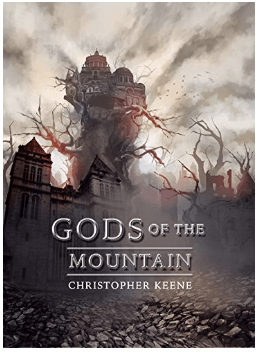
gods of the mountainI’ve been keeping fairly quiet on social media for a while lately, and as an author I’ve been effectively silent for several months. However, I’m still reading plenty and I’m still writing plenty, though not as much as I should be. Any writer would tell you the same, I think. None of us write quite as much as we want to, or we should.

At any rate, what I’m posting here today is the fortieth indie book review on this blog, for the fantasy novel Gods of the Mountain by Christopher Keene, the first (and so far only) book of the Cycle of Blades series. I hope to get a few more reviews here during 2018, but I can’t make any promises right now.

Gods of the Mountain is set in an essentially medieval world, like most fantasy, though there are no magical races or classic mythical creatures here. The setting is the repressive Avaani Empire, where most of our characters live in the major city of Tyria. Near Tyria is the  eponymous mountain, where a religious sect of magic practitioners called the Lunari worship entities called the Ksai, whom they understand as the source of their magical powers. The Lunari are able to use symbols which they hold in their minds to endow themselves with comic-book-like abilities such as flight, strength, speed, teleportation, and others. The Avaani people distrust the Lunari, and the Lunari view the Avaani as a race of godless ignorant blasphemers.

As the action picks up, an Avaani assassin and mercenary named Kessler appears wielding Lunari powers in a quest for revenge against the empire. He is manipulated from the shadows by a mysterious renegade Lunari, and part of his plan is to train up other outlaws in Lunari magic to join him in his quest. Our protagonist is Faulk, an Avaani soldier-turned-mercenary who is unwillingly trained by Kessler and soon becomes a fugitive of the Avaani law enforcement, embodied in the sadistic High Inquisitor Mullen, a bloodthirsty and crafty man who excels in torture and other unkind practices. When the antics of these rogue magic-users attracts the attention of the Lunari, a pair of Lunari come down from the mountain to rein them in, and in the process attempt to recruit Faulk into their sect. Being a godless Avaani, Faulk is skeptical of their tales of Ksai and devotion and heresy. As these and other events unfold, there are revelations and plots and schemes in the world of humans and the world of gods, culminating in an explosive climax.

Gods of the Mountain had its share of strengths and weaknesses. It had an original plot and some new ideas that I hadn’t seen in fantasy before. The way magic worked was entirely its own, although it reminded me some of the novel Elantris by Brandon Sanderson, and I saw that Keene listed Sanderson as one of his influences, so this is not too surprising. The book does well with heightening mystery and intrigue throughout, and in fact we don’t learn the villain’s identity and motivation until near the very end of the novel. One weakness of the book was the indistinct personalities of the some of the characters. A few of the more important characters spoke and acted essentially the same, and that diminished the reading experience some. The book ends on something of a cliffhanger, being the first book of a planned series. This didn’t bother me, but it might bother some readers. Being an adult fantasy novel, the book also has its share of violence, profanity, and sexual content, so more sensitive readers might want to avoid it for those reasons.

All in all, I enjoyed the book and I’d be curious to see what else this author has out there. Fans of fantasy and people looking for books with less conventional plots are likely to appreciate Gods of the Mountain.

And now once again, my bit of advertisement. If you are a fan of fantasy, you can look into my own book, Tales of Cynings Volume I, in print format here or Kindle format here.

New Book Review 39: A Keeper’s Tale

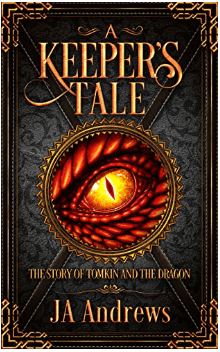
A Keepers TaleThe thirty-ninth book indie book review I’m doing here is for A Keeper’s Tale: The Story of Tomkin and the Dragon, by J.A. Andrews. Way back in August 2016 I wrote a review for this author’s high fantasy novel A Threat of Shadows, which is one of my favorite indie fantasy novels. If you like, you can find that review here. A Keeper’s Tale is presented as a fable told and retold by people in the world where A Threat of Shadows takes place, and consequently is a little more like a fairy tale than a high fantasy novel.

Our protagonist is Tomkin, the younger and less-favored son of a duke in a dull kingdom called Marshwell. Tomkin is a teenage dork, peevish, too weak to lift a sword, hardly the heroic archetype. He is sent on a quest through two coinciding events: learning that he’s been betrothed to a reputedly shrewish woman, and learning that a dragon has allegedly been devouring local livestock. Before long our brave hero finds himself trapped in a ruined castle alongside a moody dragon named Vorath, a longsuffering kobold named Wink, and a sarcastic young woman whom he calls Mags. The primary plot involves Tomkin’s attempt to escape his predicament, with the supporting characters helping and hindering him in various ways.

Tomkin and Mags are fairly well developed as characters. Thy both have some gaps in their backstories, but they think and act in pretty credible ways. Vorath initially seems like a pretty stereotypical Smaug-esque dragon, but he gets some good development as well. I would have liked to see more development in Wink the kobold, as I was left with a few questions about his personality, motives, and background. That being said, I think it’s to the story’s benefit that there are so few characters. We’re able to get to know those characters without being distracted by keeping track of a wide cast of side characters. Overall I thought characterization was done very well.

For the first half of the novel, everything is pretty light and comedic, and there are notable nods to other mostly light-hearted fantasy works like The Hobbit and Alice’s Adventures in Wonderland. Around the halfway point there is a pretty significant mood shift. Learning more about how Mags and Vorath have come to be in the castle raises the stakes in the story, and it gets to be a little less light-hearted and a little more serious. That being said, the story and Andrews’s writing in general are proudly noblebright fantasy, and the menace stays PG and never quite reaches PG-13 or R. Fantasy fans who favor heavier, grimmer stories might dismiss this more positive fantasy as infantile or pointless, but I appreciate a wide variety of fantasy and thoroughly enjoyed the book. I suppose the target audience might be teenagers and kids rather than adults, but as an adult I liked it, and I think many other fans of the genre would too.

And now once again, the plug. If you are a fan of fantasy, you can look into my own book, Tales of Cynings Volume I, in print format here or Kindle format here.


New Book Review 38: Casting in Stone

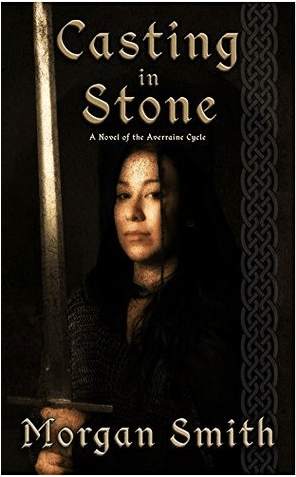
casting in stoneThis is the first new review I’ve done since September. Working as a substitute teacher and maintaining a handful of other jobs have taken up a fair amount of my time, so I haven’t been writing as much or supporting other indie authors as much as I should. That’s not a great excuse, and I mean to do better in the near future.  Now, this latest review (number thirty-eight) is on Morgan Smith’s Casting in Stone. Way back in August 2016 I reviewed Smith’s A Spell in the Country, which is one of the best indie fantasy novels I’ve come across. You can read that review here. Both of these books are in Smith’s high fantasy series The Averraine Cycle, taking place in the same world and referencing some of the same locations and history, but not sharing characters or plot points.

Like A Spell in the Country, Casting in Stone is told from the first person point of view of a tough and fierce warrior, a woman in a medieval-esque land of castles, knights, and dangerous magic. Our hero is Caoimhe, an orphan with notoriously ill luck and a penchant for killing. In a flashback we learn that she served as champion for a young duke named Einon during a period of power struggle and court intrigue in the town of Rhwyn. There were a lot of court intrigues in the story, and I regret to say that I couldn’t very well keep up with all of them. The main story was centered on Caoimhe’s investigation into a curse that she believes has been plaguing her, and the ways that the people around her manipulate her to keep her ignorant of the curse or help guide her to discovering the source of the curse.

There’s some action in the story: descriptions of one-on-one battles between champions, descriptions of skirmishes against feral supernatural wolves, battle against wicked supernatural entities. With the descriptions of fighting and the daily routines of being a soldier in this kind of grim pre-industrial fantasy world, the author spares no detail. The weapons and processes and fighting techniques are elaborated in a way that reveals how much time Smith researched her source material, creating a very believable setting. This was the case in A Spell in the Country as well, and I’m again impressed and inspired by it. In my own fantasy work, I would do well to imitate that commitment to research. That being said, there were long stretches of the book where things moved slowly, and where I really wanted to see more things happening. Where the story was interesting, it was great, but there were stretches when it dragged on.

As someone who appreciates quality high fantasy, I definitely appreciated this book, and I think other fans of the genre will appreciate it as well. I’m keeping an eye out for other works in The Averraine Cycle.

Now, once again, my bit of promo. If you are a fan of fantasy, you can look into my own book, Tales of Cynings Volume I, in print format here or Kindle format here.

New Book Review 37: Deep Space Accountant

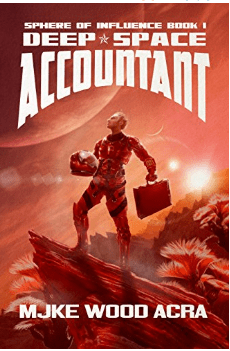
deep space accountantMy next indie book review is for the sci-fi novel Deep Space Accountant, by Mjke (yes, that’s the correct spelling) Wood, the first book in the Sphere of Influence series. This novel starts out with strong comedic overtones, but as it develops the story becomes closer more like a thriller. The novel is set in the 23rd century, in which humans have abandoned the scoured and polluted ruins of Earth and spread throughout the universe. The sum area of human habitation is known as the Sphere of Influence, but most of Earth’s biodiversity perished with Earth, including all trees and most animals. Lightspeed travel, teleportation, vat-grown meat, and a sentient AI companion called an imentor (using the pronouns Jim or Kim, depending on the gender of the user) are regular parts of life in the 23rd century.

The protagonist, the Deep Space Accountant in question, is Elton D. Philpotts, an everyman nobody sort of character who works a mediocre job as an ordinary ground-bound accountant but aspires to the lofty and glorious position of a deep space accountant. Not being an expert in Relativistic Accountancy (that is, assessing costs involved with lightspeed travel, the wear and tear on spaceships, and so forth), he is utterly unqualified and can only dream. It’s notable that since genetic modification of embryos is a regular part of the future, a botched attempt at making him a superior human left him with the ability to memorize any number he sees. This is useful for his job, but no replacement for Relativistic Accounting experience.

Despite his lack of qualifications, Elton lands an interview with Space Corps for a deep space accountant position, and despite the comical awfulness of the interview, he gets the job, boards a shuttle which promptly explodes, and finds himself fleeing for his life from a sinister corporation which had meant to use him as a scapegoat and pawn in their wicked schemes for…well, if you want to know what the schemes are you’ll have to read the book, because I’d hate to give further spoilers.

The writing is smooth, without the nagging little errors I’ve come to expect from so many indie novels. The humor does fade as the story progresses, but it’s good where it is. Elton, a mediocre accountant who is forced to be a hero, is an entertaining character. With his ticks and quirks and so on, I can imagine him being a character in a Wes Anderson film, which was endearing for me.  The secondary characters weren’t all quite as strong, some of them kind of blended together for me, but that’s not so bad. There is a romantic arc to the story which was a little improbable, but it’s a genre of improbable things, so that’s not so bad either. Elton really does have “plot armor”, consistently surviving shootings and crashes and explosions and so forth because the story needs him alive, but being a comedy, this sort of thing is expected. There was one weakness to the story, in my opinion. The main antagonist, a Space Corps bigwig named Martin Levinson, is a pretty clichéd character. He’s a bad guy in a business suit, driven by greed and sociopathy without any meaningful complexity behind him, and characters exactly like him have been oozing their way through the offices of sci-fi in various media for decades.

All in all, the story was a good one. I enjoyed it, and I’d recommend it for fans of comedy (specifically off-beat comedy) and sci-fi (including hard sci-fi, which we so rarely see). I’d especially recommend it for sci-fi fans who are looking for something fresh and different.

Now, once again, my bit of promo. If you are a fan of fantasy, you can look into my own book, Tales of Cynings Volume I, in print format here or Kindle format here.

New Book Review 36: Demorn: Soul Fighter

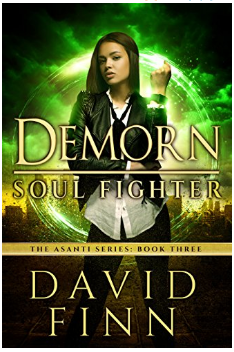
demorn 3The next indie book review I’m doing is for David Finn’s sci-fi fantasy space opera all-around actionfest, Demorn: Soul Fighter. This is the third book of the Demorn series, and I reviewed the first and second of them last year. Those reviews can be found here and here.

As a quick refresher on the premise, Demorn, the Wandering Princess of Swords, is a witty (and sometimes nihilistic) young woman who has time-travelled, space-travelled, and dimension-travelled throughout a multiverse that’s crumbling under the weight of imminent cosmic calamity. She is an extraordinary fighter, making use of guns, fists, a supernatural flaming katana, and a variety of magical objects gifted to her by gods and other entities in her wide and varied travels. She has been a priestess, arena fighter, and presently a mercenary. She also really loves comic books, and is good friends with Frank Sinatra, who happens to be a leader in a resistance against cosmic baddies.

Each of the Demorn books has had a common difficulty. In their freneticism and dimension-jumping and panache, they are confusing as hell. They’re all packed with action which is so well-written and so detailed that it’s a beauty to read, but keeping track of the plot is always challenging. In Soul Fighter, a catastrophe called the Fracture Event has torn apart the multiverse, erasing past timelines and sending beings from one dimension into another, wreaking all kinds of havoc. Members of a cultish organization called the Triton Corporation initiated the Fracture Event for diabolical purposes involving wicked cosmic gods (fans of H.P. Lovecraft will recognize the concept). Demorn starts in a Las Vegas-like metropolis called Bay City, where she competes in Soul Fight tournaments. Each fighter carries several mystical skulls which contain a soul, enabling them to fight and die multiple times. The loser of a fight has their soul-skulls taken away by a Death Banker, shadowing persons with their own motives and allegiances. From this setting, Demorn turns from gladiator to assassin to hunt down one Death Banker who means to release a cross-dimensional plague on the city. This sets her on a path to encounter an old friend and sometimes enemy, Iverson, an operative and detective-like character with whom she embarks on a quest to find the Reset Pyramid, which will enable them to reset time and avert the Fracture Event. Along the way they encounter former friends and rivals and lovers (Demorn, I nearly forgot to mention, is a lesbian), including Demorn’s brother Smile, her former co-priestess Toxis, her former lover Winter, the powerful warriors Wolf and Wrecking Ball, and the white-collar foes within the Triton Corporation. This book also has a brief appendix to help keep track of all the characters, factions, and magical items in the series.

I can’t stress enough that despite how confusing these books are, I love them. Each of them has been an incredibly fun read, and I’d highly recommend them for fans of sci-fi and fantasy.  Reflecting on the way the stories work, I see a lot of influence from comic books especially. With the variety of worlds and scenarios and the vivid descriptions, I’ve wondered if the books might be enriched if they were in fact graphic novels instead of prose novels. If the author ever does make a graphic novel of the series, I would be excited to read it, and I certainly look forward to the release of the fourth book in the series, titled Demorn: Ultimate Fate.

Now, once again, my bit of promo. If you are a fan of fantasy, you can look into my own book, Tales of Cynings Volume I, in print format here or Kindle format here.

New Book Review 35: Across the Realm: Life Always Finds A Way

Across the realm 1Again, I’ve gotten off track with these reviews, but again I’m trying to keep at it. This time, I’m reviewing Isobel Mitton’s novel Across the Realm: Life Always Finds A Way. This is the first of the space opera series ‘Across the Realm’, which includes a sequel titled Across the Realm: When Two Tribes Go to War.

When I was asked to read and review this book, I must admit to the cardinal sin of judging a book by its cover. The cover of the first edition looks unfortunately amateurish, and on the basis of that I assumed that I’d read the first twenty percent of this book and conclude that it wasn’t worth my time, as I’ve done for several other indie books. But, this book surprised me. The prose had some rocky points but overall was pretty good, there were relatively few editing errors, and the premise, while certainly out-there,  caught and kept my interest. It’s also noteworthy that more recent edition have a new and more professional cover, which I am including in this post.

The book is set in the year 2699. A cultural and physical divide has split the Earth into a northern “realm” and a southern “realm”, which have been at war for centuries. In the north humans live under strict racial segregation. Apart from space travel, they haven’t had a great many scientific breakthroughs since the 21st century, and their understanding of science, specifically biology, is distorted by their racial ideals. In the south, humans have radically altered into cybernetically enhanced telepathic superhumans who breathe argon and whose bodies are in some way composed of mystic energy. They are racially integrated and mixed, they live for centuries because disease has been eradicated, they have eliminated reproduction by growing embryos in tanks, and they worship their ancestors and Mother Earth, the source of their energy. Water is absolutely poisonous to them. A force field separates the north from the south and both sides seek to break through the force field and conquer the other side of it.

((((((((((((((((SPOILERS HERE IN THIS PARAGRAPH))))))))))))))))A convoluted Romeo-and-Juliet sort of situation develops between Greg, a man and high-ranking soldier from the north, and Naledi, a woman and elite warrior of the south when the two crash onto a planet together after a space battle. Prior to this Naledi received a vision in which she was instructed by her ancestors to restore the humanity of the South, which had deviated too far from natural humanity. Along with Greg and Naledi’s storyline, there are numerous other characters, fighters and spies and priestesses and scientists and so forth, all influencing the direction of the war. The book ends on a cliffhanger, with an enormous battle between the two sides about to begin.

As I said earlier, the premise is out there. Obviously the world and setting are not realistic. The science presented in the work is all nonsense, which we generally accept and overlook in space operas (midichlorians, anyone?). That being said, the story was so committed to its world and so detailed and specific in what it’s like and how it came to be that way that I couldn’t help but be impressed. Some of the character motivations were murky and strained credibility at times, but the main story arcs where engaging and intriguing, and I’m pleased to say that I quite enjoyed the book.

Fans of sci-fi and space opera and readers looking for something original and unique are likely to also enjoy this book.

Now, once again, my bit of promo. If you are a fan of fantasy, you can look into my own book, Tales of Cynings Volume I, in print format here or Kindle format here.

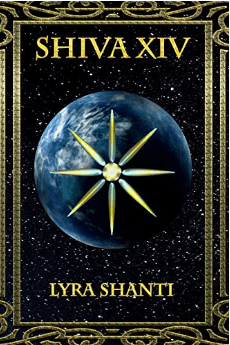
New Book Review 34: Shiva XIV

shiva xivThe next book review on this site is Lyra Shanti’s science fiction/space opera novel Shiva XIV, first of the Shiva XIV series, which currently includes three novels and one short story. The series is set in what seems to be a distant future, where humans have established civilizations on several different planets throughout the universe.

The protagonist of the novel is Ayn, the son of the queen of the planet Deius. All of the people on Deius follow a strict religious doctrine, and Ayn is declared at birth to be the fourteenth incarnation of Shiva (a god from real-world Hinduism, although I wasn’t sure if he is meant to be the same god in this novel) and the second incarnation of the spacefaring historical figure The Great Adin, and is consequently given the messianic title Bodanya. As the Bodanya, Ayn is expected to fulfill an ancient prophecy and lead his people into a new age by solving the Great Paradox, a sort of theological issue for the people of Deius. Ayn also happens to be born intersex, with both male and female genitalia. The story follows him from his time as an infant to his early adolescence.

In this future universe, there are ideological divisions among the planets between those who follow religious doctrines and those who strictly follow science. The planets Kri and Ohr are two planets whose people follow science, and as such they are sometime rivals and sometime allies of Deius. The novel’s plot gets going when a meeting of the leaders of these three planets meet, and anti-religious Deiusian extremists attempt to murder Ayn. Ayn escapes with the help of the Ohrian prince, Zin, and adventures and conflict ensue.

The novel’s premise is dynamite. When I started reading it, I immediately began comparing it with Frank Herbert’s Dune for its concept of how religion and cultural divides could continue to shape society even when humanity expands beyond the constraints of our solar system. The beginning of the novel, in my opinion, was its strongest point. Later on though, I thought the novel weakened in some ways. One of Ayn’s mentors is a priest named Pei, and after Ayn and Zin leave Deius he has both a romantic arc and a warrior-training arc, and neither story arc seemed very believable to me based on what the character is like. The friendship between Ayn and Zin also stretched credibility for me. Some aspects of the prose irked as well, specifically use of exclamation points from a third-person omniscient narrator.

But, the novel had its strengths as well. The various settings and otherworldly cultural aspects were described quite well, and with its twists and intrigues and surprises, I wasn’t ever bored with the story. There’s a lot of potential here, not all of which was realized in the first book (which, if I’m not mistaken, was the author’s debut novel), and that gives me hope that the others in the series may expand the novel’s universe and achieve more of its potential while avoiding some of the pitfalls that this novel fell into. With that in mind, I think I will most likely continue with the series and read its second book, The Veil of Truth.

Now, once again, my bit of promo. If you are a fan of fantasy, you can look into my own book, Tales of Cynings Volume I, in print format here or Kindle format here.

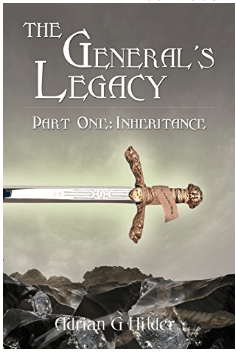
New Book Review 33: The General’s Legacy: Inheritance

general 1I’ve been taking a break from blogging and reviews for a little while, but I mean to get back into it now. The next book I’m reviewing is The General’s Legacy: Inheritance by Adrian G. Hilder, the first of the ‘General of Valendo’ series. The series (which so far includes just two books) is high/epic fantasy, set in a medieval-style world of kings and knights and wizards.

As explained in the prologue, the land of Valendo is the neighbor and sometimes enemy of the land of Nearhon. The heroic general Garon once fought against the invading people of Nearhon with the aid of the warrior Quain and the mage Zeivite. The opposing country fought using supernatural monsters called Rippers, summoned by a wicked mage named Magnar. Garon and his companions defeated the invaders and brought peace to the land, and the book’s main narrative begins decades later when Nearhon begins showing signs of new aggression. The heroes of the former war are now gray and elderly veterans, training the new generation for the possibility of another war. The main character is Cory, the grandson of Garon, who becomes romantically involved with Julia, the princess of Nearhon, with the hopes of their union helping to keep the peace between their lands. The story sort of crawls along with that plot for a while, until things pick up when Magnar manages to bewitch a prince of Valendo, Pragius, transforming him into a necromancer who raises an army of burning undead skeleton soldiers to conquer Valendo. This is the most prominent use of magic in the book, and for that I suppose a reader might choose to categorize the book as dark fantasy.

I don’t want to give too serious of spoilers for any of my readers who might want to look into this book later, but one peeve I have with this book is its lack of resolution. It ends with a cliffhanger, and for me the narrative arc felt very incomplete. Readers have different opinions about cliffhangers of course, and some readers wouldn’t be bothered by it. The book had a neat premise for me, and that was a strength for it. Lack of originality is an issue I’ve seen with a lot of indie/self-published fantasy, and this particular book had a story that I haven’t seen before, so I was pleased with that.

One persistent issue I had with the book was the way that it used metaphor and personification. It’s good for writing to be descriptive, but this book used a lot of descriptions that didn’t make very much sense and overall diminished the quality of the book.  There were also a fair number of typoes and editing errors throughout the book. Of course, this happens with self-published work and I’m certainly in no position to condemn.

To wrap this up, I’ll say that The General’s Legacy: Inheritance will appeal to fans of the genre, and is a promising first work for a fantasy series. I found it enjoyable.

Now, once again, my bit of promo. If you are a fan of fantasy, you can look into my own book, Tales of Cynings Volume I, in print format here or Kindle format here.

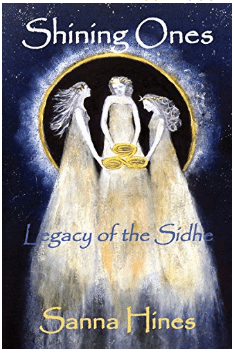
New Book Review 32: Shining Ones: Legacy of the Sidhe

shining-onesThe next book I’m reviewing here is Shining Ones: Legacy of the Sidhe, a modern fantasy novel by Sanna Hines. The book takes place in the 21st century, primarily in Ireland, Wales, and Scotland, and draws heavily on the legend and mythology of that part of the world for its fantasy elements.

In the book’s backstory, the magical races of the Danann and the Formorians have been at war for centuries, a war which has taken place over a few different parallel dimensions and which has employed magical weapons and strategies which have shown up in our world’s mythologies in various ways. Characters such as Merlin (of the Arthurian legends) and Finn Mac Cool (of Irish legend) were and still are immortal players in this conflict, and legendary items such as the sword Excalibur and the Four Treasures of Dagda (Sword, Spear, Cauldron, and Stone) have all played roles in this conflict. I’m not especially familiar with this particular area of mythology, but I can imagine somebody else really geeking out over it.

The story gets set into motion when a teenage girl named Lia is kidnapped by Formorians, who have plans to use her in their quest to discover the secret behind Danann immortality. Lia’s father, Sam, has to set out on a quest to save her, with the help of the Danann woman Tessa, her nephew Cory, a dog named Cu, and several other characters who all have some connection with the ongoing conflict. Tied up in all of this are teleportation portals, ancient temples, and a ritual involving the alignment of three asteroids in the shape of the mystical triskelion symbol.

I recognize that this book’s worldbuilding is excellent. It created a believable and detailed world by merging together disparate mythologies, real-world geography, and science. I was impressed with this. That being said, I had a lot of difficulty keeping track of who the characters were. I know that some were ordinary humans and some were of the magical races, but in terms of the way they interacted with each other, they weren’t very distinct. In the final quarter of the book some of the mysteries about the different characters’ pasts and connections were revealed, and in that section I was able to see clearly how the characters were different, how their different backgrounds had led them to play the role that each had played in the story. But, there were at least a dozen other characters besides those I’ve named here who all were important yet indistinct until the last quarter, and this was a problem for me. Having finished the book, I feel like if I reread it knowing the ending I would be able to get more out of it, and appreciate the story more.

Overall, it was an enjoyable (if confusing) read, a fantasy work not quite like any that I’d read before. I should note, though, that the book is written for adults, not children. It does have some profanity and a fair amount of strong sexual innuendo and implied (if not totally descriptive) sex scenes which most parents probably wouldn’t want their children or young teenagers reading.

Now, once again, my bit of promo. If you are a fan of fantasy, you can look into my own book, Tales of Cynings Volume I, in print format here or Kindle format here.
As a final note, I might not be able to post reviews to this blog as frequently as before, as I’m working a lot now and devoting a lot of time to writing my second book, Tales of Cynings Volume II. Reviews here may come every two weeks, or even less often.