
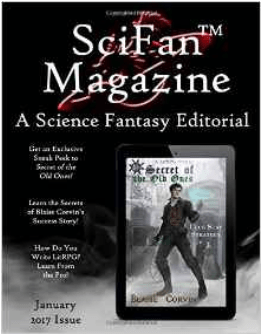
 The next book review I’m doing is a little different than the previous ones. I’m reviewing the January 2017 edition of SciFan Magazine, a monthly digital magazine designed to showcase current and upcoming independent authors. The editor is Richard M. Mulder, whose work I hope to review at a later date. There were thirteen stories/excerpts in the magazine, and I will address each of them here.
The first, ‘Octov’s Rise to Ainoren’ by Dawn Chapman, is an excerpt from the novel The Secret King: Lethao, which I reviewed on this blog here. Chapman’s work is excellently written, with strong detail and description and otherworldly characters who are familiar enough for the reader to empathize, yet whose otherworldly attributes and powers create a sense of wonder while reading. This particular excerpt is full of action and intrigue, and I liked it.
The second, ‘Séance on Death Row’ by Douglas Kolacki, is a short horror story in which a group of people, including a murderer, hold a séance to speak with the murderer’s victim. It was an older style of horror, relying heavily on implication and imagination, with dread permeating the story and with the horror stemming from forces beyond the grave which may be seen but not fully understood. It reminded me of Edgar Alan Poe’s work. I liked it.
The third, ‘The Tot of Wonder’ by John Taloni, is a much more lighthearted and goofy tale of a superhero father who lives with his non-super wife and his super-powered toddler son. There’s not a whole lot to it, but I think it’s geared more toward a young audience. It felt a little out of place in this magazine, but as a work for children I suppose it’s fine.
The fourth, ‘Miss Soames’ by Kyle Hemmings, was an odd one. I can’t say much about it without completely spoiling the story, but I didn’t like it very much. The prose was okay, but the plot was kind of nonsensical, a sort of bait-and-switch horror story that was so busy trying to surprise the reader that it forgot to be scary.
The fifth, ‘Orlok’s Song’ by David Castlewitz, was my favorite in the magazine. In this short story, there is a sentient species called the Peet (animal-like beings) who have been driven from their forest homes by human enterprise. Orlok is the father of a family that tries to survive in the new concrete forest of city slums. The writing in it was beautiful, and the story was brief but excellent in its narrative and conclusion. I’d definitely recommend this one.
The sixth, ‘Voices Beneath the Ice’ by Matthew McKiernan, is a sci-fi story with horror elements involving a trio of astronauts who land on Europa (a moon of Jupiter) and begin to find strange reasons to hate each other. I liked the concept a lot, but some of the prose needed work. I think this story has a lot of potential, and could be really great if some more time was given to it.
The seventh in the magazine is an excerpt from the book Secret of the Old Ones by Blaise Corvin. Its genre is given as LitRPG Sci-Fan™, in which the real world and the world of gaming are both important to the narrative. The only issue I have with the excerpt is that the character never seemed to really be in danger, but since it’s just an excerpt of a larger work, I’m sure there will be more conflict and excitement later in the story. I really liked this excerpt, and I’ll probably read the book at some point.
The eight is also an excerpt, titled ‘The Stirring’ by Jaren Fleming. It was something like Christian creationist science fiction, about a planet that serves God (here called The Father) at war with gooey alien beings that serve Satan. The whole excerpt was nothing but combat, and the writing was good, but I hope there is character development and more fleshing-out of the story in the larger work. I wasn’t a huge fan of the premise, but I can imagine other people liking it quite a lot.
The ninth was ‘Stormguard: The Invisible War’ by Tom Fallwell. It was another case of Christian-themed action sci-fi. I can’t say much about it without spoiling the whole story, but it starts with a man waking up in a crater with no memory of who he is or where he came from. The writing was okay, but I thought the premise was kind of a cliché. This was an excerpt of a larger work as well, but I probably won’t seek out the larger work.
The tenth, ‘Spacejacking’ by Russell Hemmell, seems like it may be an excerpt from a larger work, but it was unclear to me. It’s a futuristic tale of an alien abduction during space exploration, and the subsequent consequences. Again, I can’t say a lot without giving away the entire story, but I liked this one. It had some interesting and unusual ideas in it, and if it is part of a larger work I’d like to see where the story goes.
The eleventh story, ‘The Brat and the Other Country’ by David Perlmutter, was a real oddball. The premise was similar to the film ‘Who Framed Roger Rabbit?’, if that film was a story about superheroes rather than a detective story. In the story, the cartoon characters of Earth actually live on another planet, and the main character is a superhero human who works alongside superhero cartoon characters. I can imagine other people really loving the premise, but it was just a bit too much of a stretch for me.
The twelfth story, ‘In the Hot Mists’ by John A. Frochio, is a steampunk tale about an airship race in which one airship has an unfair advantage because it’s crewed by extraterrestrials. Strange as this premise is, I liked it. The writing was good, it put a new spin on a familiar story, and I think lots of other people would enjoy the story too.
The last story (good job for sticking with me this long!) is ‘The Keystone Islands: Portals of the Grave’ by Lander Allen. It’s the first three chapters of a larger work, a soft sci-fi work set in a universe where Earth is a cultural center resented by the other planets. The tetrapath infection turning its victims into horrific monsters, and the protagonists have come from who-knows-where and are trying to figure out their past in the midst of this plague. It’s well-written and very intriguing, and I’d like to see where the story goes.
So, those are the thirteen stories from the January 2017 edition. I expect to review later editions of the magazine in this blog as well, as it seems like a great way to see at a glance what’s going on in the indie fantasy and sci-fi community.
Now, once again, my bit of promo. If you are a fan of fantasy, you can look into my own book, Tales of Cynings Volume I, in print format here or Kindle format here.
 Cameron W. Kobes