
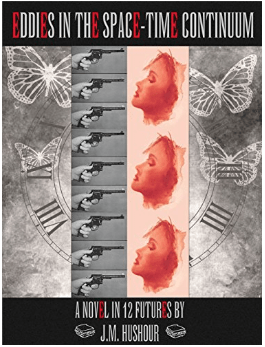
 The next book I’m reviewing here is Eddies in the Space-Time Continuum by J.M. Hushour, a thoroughly unconventional comedic sci-fi novel. This is going to be a longer review than the others, because there is a lot to say about this work. I downloaded the ebook over two years ago and discovered three things: one, the writing is phenomenal; two, the book does not exist in print; and three, the book would be over a thousand pages long if it did exist in print. I don’t enjoy reading ebooks as much as I enjoy reading print books (I know, it’s 2018, sue me) and this book’s improbable length added to that issue, but the writing was so good that I wasn’t willing to give up on it. So, I tried and retried this book a couple of times before I finally got a running start at it and spent a month reading through the whole darn thing. It was most definitely worth the read, but likewise reading it was a real chore.
The novel consists of twelve chapters. Each chapter (with one exception) takes place on March 30, 2050, the birthday of our protagonist, Eddie. As we gradually learn, Eddie has a condition similar to that of Bill Murray’s character in Groundhog Day or Tom Cruise’s character in Edge of Tomorrow. He is constantly reliving the same day. In this author’s interpretation of the theme, each repeated day that Eddie experiences is in a different version of the future. Humanity just keeps on finding new ways to make itself miserable, and Eddie is witness to every one of them. Doom by rising sea levels. Doom by corporatocracy. Doom by plague. There is always some monstrous crisis coming to a head on Eddie’s birthday.
In every version of the future, Eddie is a physically imposing but gentle-hearted creative type, fairly befuddled by his place and time. He owes some inspiration to Douglas Adam’s baffled protagonist Arthur Dent (and, the book’s title is itself a reference to The Hitchhiker’s Guide to the Galaxy). Eddie is inevitably and hopelessly in love with Viola, a Scottish woman who in every version of the future is some kind of outsider radical extremist, in her own mind fighting to free the world from its present crisis. Though their first meeting in the first version of the future was filled with quite a lot of hostility, every subsequent future brings them closer and closer together, with Eddie becoming braver and stronger in each repetition, and with cycles of déjà vu and shared recurring symbols—an enigmatic sandwich, the Shakespeare play Twelfth Night, butterflies—revealing to Eddie and Viola that they have met each other over and over again in different versions of their reality. Binding all of these realities together is the mystical notion of the qutb, something like the axis of a wheel, a notion taken from Islam and explored in this work. Also in each reality appear a cast of characters whose fates are bound with those of Eddie and Viola. To name a few key players: Hijack, Eddie’s sometimes-male-sometimes-female sibling who is a sort of drug dealer Willy Wonka; Aivia, a woman who is inevitably in the process of using science to change into a bird; Hélolard, sometimes a therapist, sometimes a cyborg stripper, sometimes a military commander, usually a mentor, always taking command over Eddie; and, crucially, the antagonist, a mysterious entity called the Queen of Hurts, who is always appearing to tear down reality. If I haven’t made this clear yet, it’s all a lot to take in.
One of the reasons this book impressed me from the very beginning was its intense, colorful use of language as a vehicle for ideas, delivering metaphors and zingers and philosophical notions in every sentence, keeping the scene interesting even when little was happening. It reminded me a lot of the books I’ve read by Tom Robbins (and, I saw that this author listed Tom Robbins as an influence). The book is very funny from the very beginning, funny in a Douglas Adam kind of way, but as it goes on and the nature of the book’s central threat becomes clearer, the tone becomes much more serious. The change happens slowly, so much that you might not notice it happening unless you get a ways into the book and begin comparing one chapter to another. With all this business of multiple realities and multiple speculations about the future, sometimes the book got very confusing. There were times when the events on the page really didn’t make a lick of sense. But, I was so impressed by the work as a whole that this didn’t bother me at all.
Readers should be aware that this is a book for adults, with quite a lot of violence and sex and coarse language and coarse themes and so on. Some readers are put off by that. As for me, I was blown away. I really wish this book existed in print, because I want it on my shelf. I want to be able to flip through physical paper pages of it and enjoy it that way, because it is a masterpiece. I would highly recommend it to a wide variety of readers: fans of science fiction, fans of comedy, fans of absurdism and surrealism, readers looking for new and original ideas, etc. This book seems to be pretty obscure right now, but I don’t think it should be. I think a really wide audience would and should appreciate this book as much as I have.
And now, as I always do in these reviews, my bit of advertisement. If you are a fan of fantasy, you can look into my own book, Tales of Cynings Volume I, in print format here or Kindle format here.
 The thirty-ninth book indie book review I’m doing here is for
  My next indie book review is for the sci-fi novel
  The next indie novel I’m reviewing here is
  Cameron W. Kobes