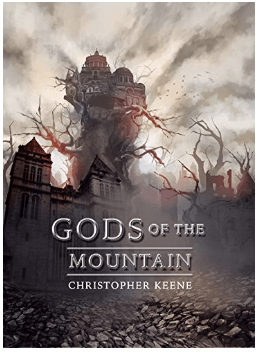
New Book Review 40: Gods of the Mountain

gods of the mountainI’ve been keeping fairly quiet on social media for a while lately, and as an author I’ve been effectively silent for several months. However, I’m still reading plenty and I’m still writing plenty, though not as much as I should be. Any writer would tell you the same, I think. None of us write quite as much as we want to, or we should.

At any rate, what I’m posting here today is the fortieth indie book review on this blog, for the fantasy novel Gods of the Mountain by Christopher Keene, the first (and so far only) book of the Cycle of Blades series. I hope to get a few more reviews here during 2018, but I can’t make any promises right now.

Gods of the Mountain is set in an essentially medieval world, like most fantasy, though there are no magical races or classic mythical creatures here. The setting is the repressive Avaani Empire, where most of our characters live in the major city of Tyria. Near Tyria is the  eponymous mountain, where a religious sect of magic practitioners called the Lunari worship entities called the Ksai, whom they understand as the source of their magical powers. The Lunari are able to use symbols which they hold in their minds to endow themselves with comic-book-like abilities such as flight, strength, speed, teleportation, and others. The Avaani people distrust the Lunari, and the Lunari view the Avaani as a race of godless ignorant blasphemers.

As the action picks up, an Avaani assassin and mercenary named Kessler appears wielding Lunari powers in a quest for revenge against the empire. He is manipulated from the shadows by a mysterious renegade Lunari, and part of his plan is to train up other outlaws in Lunari magic to join him in his quest. Our protagonist is Faulk, an Avaani soldier-turned-mercenary who is unwillingly trained by Kessler and soon becomes a fugitive of the Avaani law enforcement, embodied in the sadistic High Inquisitor Mullen, a bloodthirsty and crafty man who excels in torture and other unkind practices. When the antics of these rogue magic-users attracts the attention of the Lunari, a pair of Lunari come down from the mountain to rein them in, and in the process attempt to recruit Faulk into their sect. Being a godless Avaani, Faulk is skeptical of their tales of Ksai and devotion and heresy. As these and other events unfold, there are revelations and plots and schemes in the world of humans and the world of gods, culminating in an explosive climax.

Gods of the Mountain had its share of strengths and weaknesses. It had an original plot and some new ideas that I hadn’t seen in fantasy before. The way magic worked was entirely its own, although it reminded me some of the novel Elantris by Brandon Sanderson, and I saw that Keene listed Sanderson as one of his influences, so this is not too surprising. The book does well with heightening mystery and intrigue throughout, and in fact we don’t learn the villain’s identity and motivation until near the very end of the novel. One weakness of the book was the indistinct personalities of the some of the characters. A few of the more important characters spoke and acted essentially the same, and that diminished the reading experience some. The book ends on something of a cliffhanger, being the first book of a planned series. This didn’t bother me, but it might bother some readers. Being an adult fantasy novel, the book also has its share of violence, profanity, and sexual content, so more sensitive readers might want to avoid it for those reasons.

All in all, I enjoyed the book and I’d be curious to see what else this author has out there. Fans of fantasy and people looking for books with less conventional plots are likely to appreciate Gods of the Mountain.

And now once again, my bit of advertisement. If you are a fan of fantasy, you can look into my own book, Tales of Cynings Volume I, in print format here or Kindle format here.

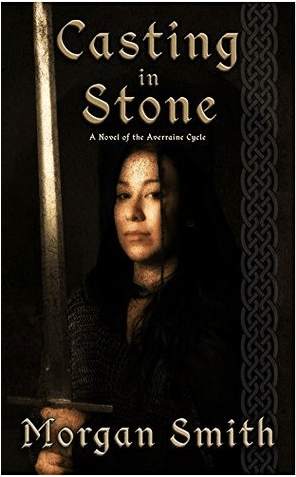
New Book Review 38: Casting in Stone

casting in stoneThis is the first new review I’ve done since September. Working as a substitute teacher and maintaining a handful of other jobs have taken up a fair amount of my time, so I haven’t been writing as much or supporting other indie authors as much as I should. That’s not a great excuse, and I mean to do better in the near future.  Now, this latest review (number thirty-eight) is on Morgan Smith’s Casting in Stone. Way back in August 2016 I reviewed Smith’s A Spell in the Country, which is one of the best indie fantasy novels I’ve come across. You can read that review here. Both of these books are in Smith’s high fantasy series The Averraine Cycle, taking place in the same world and referencing some of the same locations and history, but not sharing characters or plot points.

Like A Spell in the Country, Casting in Stone is told from the first person point of view of a tough and fierce warrior, a woman in a medieval-esque land of castles, knights, and dangerous magic. Our hero is Caoimhe, an orphan with notoriously ill luck and a penchant for killing. In a flashback we learn that she served as champion for a young duke named Einon during a period of power struggle and court intrigue in the town of Rhwyn. There were a lot of court intrigues in the story, and I regret to say that I couldn’t very well keep up with all of them. The main story was centered on Caoimhe’s investigation into a curse that she believes has been plaguing her, and the ways that the people around her manipulate her to keep her ignorant of the curse or help guide her to discovering the source of the curse.

There’s some action in the story: descriptions of one-on-one battles between champions, descriptions of skirmishes against feral supernatural wolves, battle against wicked supernatural entities. With the descriptions of fighting and the daily routines of being a soldier in this kind of grim pre-industrial fantasy world, the author spares no detail. The weapons and processes and fighting techniques are elaborated in a way that reveals how much time Smith researched her source material, creating a very believable setting. This was the case in A Spell in the Country as well, and I’m again impressed and inspired by it. In my own fantasy work, I would do well to imitate that commitment to research. That being said, there were long stretches of the book where things moved slowly, and where I really wanted to see more things happening. Where the story was interesting, it was great, but there were stretches when it dragged on.

As someone who appreciates quality high fantasy, I definitely appreciated this book, and I think other fans of the genre will appreciate it as well. I’m keeping an eye out for other works in The Averraine Cycle.

Now, once again, my bit of promo. If you are a fan of fantasy, you can look into my own book, Tales of Cynings Volume I, in print format here or Kindle format here.

New Book Review 33: The General’s Legacy: Inheritance

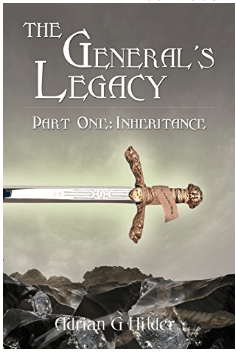
general 1I’ve been taking a break from blogging and reviews for a little while, but I mean to get back into it now. The next book I’m reviewing is The General’s Legacy: Inheritance by Adrian G. Hilder, the first of the ‘General of Valendo’ series. The series (which so far includes just two books) is high/epic fantasy, set in a medieval-style world of kings and knights and wizards.

As explained in the prologue, the land of Valendo is the neighbor and sometimes enemy of the land of Nearhon. The heroic general Garon once fought against the invading people of Nearhon with the aid of the warrior Quain and the mage Zeivite. The opposing country fought using supernatural monsters called Rippers, summoned by a wicked mage named Magnar. Garon and his companions defeated the invaders and brought peace to the land, and the book’s main narrative begins decades later when Nearhon begins showing signs of new aggression. The heroes of the former war are now gray and elderly veterans, training the new generation for the possibility of another war. The main character is Cory, the grandson of Garon, who becomes romantically involved with Julia, the princess of Nearhon, with the hopes of their union helping to keep the peace between their lands. The story sort of crawls along with that plot for a while, until things pick up when Magnar manages to bewitch a prince of Valendo, Pragius, transforming him into a necromancer who raises an army of burning undead skeleton soldiers to conquer Valendo. This is the most prominent use of magic in the book, and for that I suppose a reader might choose to categorize the book as dark fantasy.

I don’t want to give too serious of spoilers for any of my readers who might want to look into this book later, but one peeve I have with this book is its lack of resolution. It ends with a cliffhanger, and for me the narrative arc felt very incomplete. Readers have different opinions about cliffhangers of course, and some readers wouldn’t be bothered by it. The book had a neat premise for me, and that was a strength for it. Lack of originality is an issue I’ve seen with a lot of indie/self-published fantasy, and this particular book had a story that I haven’t seen before, so I was pleased with that.

One persistent issue I had with the book was the way that it used metaphor and personification. It’s good for writing to be descriptive, but this book used a lot of descriptions that didn’t make very much sense and overall diminished the quality of the book.  There were also a fair number of typoes and editing errors throughout the book. Of course, this happens with self-published work and I’m certainly in no position to condemn.

To wrap this up, I’ll say that The General’s Legacy: Inheritance will appeal to fans of the genre, and is a promising first work for a fantasy series. I found it enjoyable.

Now, once again, my bit of promo. If you are a fan of fantasy, you can look into my own book, Tales of Cynings Volume I, in print format here or Kindle format here.

New Book Review 24: Seed of Scorn

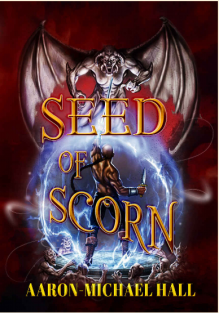
seedofscorncover.PNGThe twenty-fourth book I’m reviewing on this blog is Aaron-Michael Hall’s novel Seed of Scorn, the second of her epic fantasy series Rise of Nazil. I reviewed the first of the series, Secret of the Seven, in a previous post which may be read here. As I noted in the earlier review, this series has some representations of sexual assault. Readers who have suffered from traumatic experiences or are sensitive about these subjects should abstain from this series.

The last book [[[[SPOILERS]]]] concluded with a war to free the land of Faelondul from the tyrannical rule of the city of Nazil, whose inhabitants worshipped fascist gods and treating humans as slaves. The good Nazilian warrior, Pentanimir Benoist, has become the new ruler of Nazil, the seven true gods have revealed themselves to the land, and a new age of peace has apparently begun. As this book begins, unrest is growing among the Nazilians who favored the old order. There is talk of revolt against Pentanimir and restoration of the strict racial hierarchy of the past. In the meantime spiritual enemies of the seven gods are reaching out to make an invasion of Faelondul, pulling hapless Nazilians under their power.  The air is filled with palace intrigue and dark omens.

There is a lot going on and a lot of potential for excitement, but one thing that this book has in common with the previous one is that it moves at a glacial pace. The book is over 500 pages long, well over half of the pagespace is devoted to characters discussing the events of the previous book and characters developing their romantic relationships. In the previous book a lot of space was dedicated to graphic description of torture and rape, and this book has much less of that. It is easier on the stomach, but (and I hate to say this) for long stretches I thought it was kind of boring.

Now, to be clear, the relationships and interactions between characters were quite complex, and written very well. If I was coming to this book with the intent of reading romance, I might be thrilled with this. But, I came to it as a work of epic fantasy. Romance epic fantasy could be a genre that I’m just not familiar with, but if so it seems a very niche group, possibly someplace where fans of George R.R. Martin and fans of Nicholas Sparks overlap. I am a fan of George R.R. Martin, but romance stories bore me. This is not at all to say that the book was badly written, simply that it wasn’t for me.

On the topic of sexual assault, this book had one major deviation from the previous book and from many works of fantasy in general. In the few sexual assaults that happen in this book, the victims are male. It’s a bold move which carries an entirely different set of implications and power dynamics than the alternative, and it moves the plot forward in different ways.

Really, I think this book and this series is likely to be a love-it-or-hate-it affair for most readers. I can imagine other readers loving it. I’ve dedicated a lot of time and effort into getting this far in the series, and I haven’t yet decided if I’ll go on to the third book, Piercing the Darkness. I might, just to see what becomes of the events set up in this one.  Fans of both romance and epic fantasy will enjoy this book, though perhaps not fans of romance and fantasy respectively.

Now as always, my bit of promo. If you liked this book review, you can see my others here: New Book Review 1New Book Review 2New Book Review 3New Book Review 4New Book Review 5New Book Review 6New Book Review 7New Book Review 8New Book Review 9New Book Review 10New Book Review 11New Book Review 12New Book Review 13New Book Review 14New Book Review 15New Book Review 16New Book Review 17New Book Review 18New Book Review 19New Book Review 20New Book Review 21-New Book Review 22New Book Review 23

If you are a fan of fantasy, you can look into my own book, Tales of Cynings Volume I, in print format here or Kindle format here.
This post was originally featured on cwbookclub.com.

New Book Review 19: Secret of the Seven

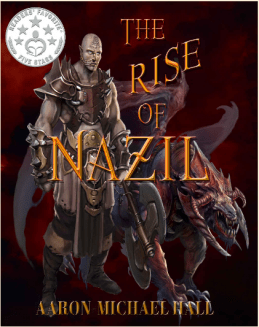
rise-of-nazil-1The nineteenth book I’m reviewing is Secret of the Seven, the first novel in the series ‘The Rise of Nazil’ by Aaron-Michael Hall. The novel is for the most part high/epic fantasy, with strong overtones of dark fantasy.  On that point, I should give a trigger warning on this review. The book contains a significant amount of rape and sexual violence, and I will speak on that content in this review. Readers who have had traumatic experiences or who are sensitive to those topics may wish to abstain from reading.

In this novel, humans are subject to rule by a race of people called Nazilians, whose capital is the city of Nazil. Nazilian society has ideology close to real-world fascism. They worship of gods embodying War, Power, Courage, and Judgment, and they obsess over racial purity. To them humans are inferior and anyone of mixed human and Nazilian blood is considered an abomination. Many Nazilians are sadistic and use terror as a way to maintain their power. Far from Nazil is the secret city of Bandari, where humans and Nazilians live in peace and harmony. One of the books central characters is Pentanimir, a Nazilian of the rank First Chosen (something like an elite military champion) who falls in love with a human woman, Brahanu. The two characters’ love is one of many pieces in the shifting dynamics of this land, which is moving toward a tipping point past which the cruel reign of Nazil cannot survive. Other pieces include the plotting of the giant Dessalonians who live on the edges of the map, and the awakening of god-like beings called Guardians (the titular Seven) who have their own plans for this world.

Apart from the occasional prophecy, there isn’t much of what we’d call magic in the story until near the end. The world is more closely related to the grit and cruelty that our own societies had during the Middle Ages. The story is strong and engaging, although it has some flaws. It moves along fairly slowly for the first two-thirds or so, setting up the pieces that bring it all to a grand climax in the last third of the book. Much of the time spent setting things up in the first two-thirds was spent on developing the romances between various characters. I’m not opposed to romance stories per se, but in this story they did slow things down quite a lot and I thought much of that aspect could have been shortened. One other aspect that I thought could have been shortened, that of sexual violence, calls for its own paragraph.

Now, I’ve read all five books in George R.R. Martin’s A Song of Ice and Fire (and I am waiting, respectfully and patiently, for The Winds of Winter). That series has gotten criticism for the amount of sexual violence in it. Secret of the Seven has more sexual violence in its 500-odd pages than A Song of Ice and Fire has in its 5,000-odd pages. It’s not left to implication and it’s not left to the imagination. It’s there, on the page, described in graphic and gruesome detail. Slaves of the Nazilians are descriptively raped, repeatedly. Captured enemies are treated to imaginative and meticulously-recounted tortures of sexual nature for dozens and dozens of pages. Every time you think the last of these scenes has passed, another one surprises you. Despite the book’s other strengths, I found this to be in poor taste.  There were times when I strongly considered putting the book aside due to these scenes, but I kept on because I was invested in the characters. So, readers who cannot stomach those kinds of scenes would do well to stay away from this book.

The prose was good for the most part, though there were typos and a handful of parts that could have used a little more editing. However as I said before, the story was good, a strong addition to the fantasy genre. I know there are two others in the series right now, Seed of Scorn and Piercing the Darkness. I will most likely read the former in a few weeks, and if it’s good I’ll go on to the latter. Fans of epic fantasy who are not too put off by gruesome graphicness will probably enjoy this book.

Now as always, my bit of promo. If you liked this book review, you can see my others here: New Book Review 1New Book Review 2New Book Review 3New Book Review 4New Book Review 5New Book Review 6New Book Review 7New Book Review 8New Book Review 9New Book Review 10New Book Review 11New Book Review 12New Book Review 13New Book Review 14New Book Review 15New Book Review 16New Book Review 17New Book Review 18.

If you are a fan of fantasy, you can look into my own book, Tales of Cynings Volume I, in print format here or Kindle format here.


New Book Review 18: Cloud Country

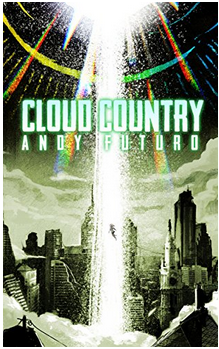
cloud-country The eighteenth book I’ll review here is Cloud Country, the second part of the Special Sin series by Andy Futuro. I reviewed the first book, No Dogs in Philly, in a previous blog post that you can read here. The series is a mix of cyberpunk, noir, dark fantasy, and Lovecraftian horror and follows a detective named Saru, a woman who fights crime in a gritty alternative version of Philadelphia. Her world includes brain-implanted internet streams, feuding cults, stray zombie-like creatures called elzi, and most importantly the conflicts between rival alien gods who see humans in a way much like humans see microbial cells. The story starts with her in the center of the devastation wrought by the events of the previous book and takes her through a new series of dangers, exploits, and revelations.

The first book was really fast-paced, and in comparison this second one is pretty slow. It centers on Saru and a Gaesporan (a member of the hive-mind-ish social elite) named John, and a lot of pagetime is spent explaining mysteries that came up in the first book and explaining the rules of this world. In the first book the supernatural implications of the events were initially unknown and Saru uncovered them little by little. Here we receive long detailed explanations of how things are and why they are the way they are. It was a bit heavy on exposition because of this. John knows the answers to all of Saru’s questions, and he explains these answers in long stretches of dialogue. The moments of action were fewer and more spaced out than in the first, but this didn’t bother me. I expect that at least one more book in the series is forthcoming, and it will benefit from having the world laid out more clearly.

One of this work’s main strengths is Saru’s narrative voice. She’s an extreme character, but she is consistent in her extremeness and her voice and attitude fits her personality. Here we see her less as a fighter and detective and more as a lost and fugitive young woman, a facet of her personality which existed in the first book but took a backseat to her hard-boiled-detective shtick. We get to know her better here, we see more of her weaknesses and insecurities. This comes in a large part from her being removed from her comfort zone, that is to say the crime-ridden alt-reality Philadelphia. In this book she spends more time in differing places and trapped inside her own memories, which uproots her and sets her in a more abstract kind of world. Due to this, the crime aspect and the cyberpunk aspect of the first book are largely discarded.

At this time there isn’t a third book in the series, and I haven’t seen any announcements for one yet. Nonetheless, I expect that there will be a third, and I look forward to it. As I said before, I enjoy this series and I’d recommend it to others. Of course, it features mature themes and isn’t for children or especially sensitive readers. It’s horror, after all. If you pick up a book of horror fiction you know what you’re getting into.

Now as always, my bit of promo. If you liked this book review, you can see my others here: New Book Review 1New Book Review 2New Book Review 3New Book Review 4New Book Review 5New Book Review 6New Book Review 7New Book Review 8New Book Review 9New Book Review 10New Book Review 11New Book Review 12New Book Review 13New Book Review 14New Book Review 15New Book Review 16New Book Review 17

If you are a fan of fantasy, you can look into my own book, Tales of Cynings Volume I, in print format here or Kindle format here.

New Book Review 17: Demorn: City of Innocents

The seventeenth book I’m reviewing here is Demorn: City of Innocents, the second book of David Finn’s Asanti series. Back in June I read the first one, Demorn: Blade of Exile, and I reviewed it on the blog here. The first impressed me enough to continue to the second, and when the third in the series comes out later this year I intend to buy, read, and review it as well. The label I gave the first book seems true of the whole series, a cross-dimensional dark modern fantasy adventure. The first book was both manically entertaining and manically confusing, and this second book toned down the manic quality of the first to create a work that was a little slower-paced but much easier to follow.

To review, Demorn is a powerful fighter who’s been engaged in wild adventures across time and multiple versions of reality for several years. Her paths have crossed with various gods, monsters, aliens, cultists, historical figures (she was all buddy-buddy with Frank Sinatra for as long as that lasted), magical objects, and so forth. She’s seen the end of the universe and witnessed the destruction of her own homeworld, which makes her a bit of a nihilist. As a priestess of the Asanti religious order she is privy to a wide variety of spells and arcane information, and as the royal-blooded Princess of Swords she’s nearly impervious to physical harm. She’s also a huge fan of 1960s music, superhero comic books, and romantic trysts with other dimension-hopping women. Demorn spent a good chunk of the last book trapped in a dimension she calls The Graveyard, and in this book she is trying to put the pieces of her life together after escaping from The Graveyard. There are a wide variety of characters (though not nearly as many as in the first book), but most of the story centers on Demorn and a godlike man she calls the Tyrant, who is alternately her close confidant and her bitter enemy as she works to avert a semi-inevitable cross-dimensional cosmic apocalypse.

The vivid storytelling and highly texture detail of the first book, its strongest points, carried over into the second. Every punch and burn and shock is felt by the character and the reader. With the story slowed down and given a tighter focus, this book was much easier to understand than the first. The complexity of the universe Demorn inhabits was still a little over my head, but it felt less overwhelming than before. The important parts weren’t so hard to follow this time around. It also helped that Demorn didn’t spend nearly as much time jumping around between worlds in this book, so I had more time to get accustomed to her locations.

For its followability, I would say that I liked this one better than the first book and I have very little bad to say about it. There were a handful of typos in the last fifteen percent of the book, which was a little unusual considering that I didn’t spot any at all in the rest of the book, but that’s not so bad. As I said before, fans of fantasy, science fiction, sword-and-sorcery, and fast-paced action stories will most likely take pleasure from this book.

And now once again, the plug. If you liked this book review, you can see my others here: New Book Review 1New Book Review 2New Book Review 3New Book Review 4New Book Review 5New Book Review 6New Book Review 7New Book Review 8New Book Review 9New Book Review 10New Book Review 11New Book Review 12New Book Review 13New Book Review 14New Book Review 15New Book Review 16

If you are a fan of fantasy, you can look into my own book, Tales of Cynings Volume I, in print format here or Kindle format here.

New Book Review 10: Incanta|Soul-Catcher

The tenth book I’m reviewing is Incanta |Soul-Catcher, the first book in the Lost Souls series by Avie Adams.  The genre is dark fantasy, which tends to mean fantasy with strong elements of horror. Now, for this particular book I was almost too skeptical to start it. I’m afraid that I judged it by its cover, which in my digital edition depicts a teenage girl with white skin, black hair, and red lips in front of a background of mountains and fog. It looked too much like YA goth supernatural romance, something like Twilight (not that there’s anything wrong with that, it’s just not my taste). But, once I started reading this book, I quickly found that it wasn’t like that at all. It was more serious, more ominous, and far more engaging.

The book’s world is utterly alien, and adjusting to it takes some time. The protagonist, a teenage girl named Cytriah, lives on an island where the buildings are molded from obsidian. She is an Incanta, a low-level acolyte in a religious order that specializes in something similar-to-but-never-outright-named necromancy. The society is ruled over by (get ready for the moral panic!) snake-like and spider-like Daemons. Within the context of the society, everybody thinks this is normal. Cytriah has a hard life, but it’s the life she knows. Intimidation by Daemons is a common threat, the cruelties of her superiors are a common threat, and it’s a fact of this world that if she fails in her role she will be condemned as a ‘Promise-bearer’, an imprisoned bearer of children. That’s her world. Cytriah’s world falls apart when she obtains new knowledge about the way it works, and why it works the way it does. That’s where the plot gets moving and the threats against her become more tangible.

The level of detail in the story is great. The world, the magical processes in it, even the gritty and foul aspects of the necromancy, are described credibly and with powerful texture. Besides this Cytriah and the secondary characters have complexity which manifests in various ways throughout the story. The only contention I really have is that in a few crucial points in the plot, there were some logical stretches. Characters took actions which were crucial to the development of the plot, which I didn’t see clear motives for. There were only two points in the story where I saw this, and it’s not a huge problem. Many stories have done this far worse.

As I mentioned at the beginning, I was worried that this would turn out to be a poorly-written supernatural romance story. There was a romance aspect to it that didn’t manifest in the plot until quite a ways through the book, but it wasn’t anything like the helpless-infatuation romance stories you expect of the genre. The romance in this story is dangerous, with consequences as ugly as all other consequences in this hideous world.

To wrap this up, I do recommend this book, though with discretion. Fans of horror may like it. Readers with qualms about blood and violence and that sort of thing will certainly not. I enjoyed it.

Now, the plug. If you liked this book review, you can see my others here:

New Book Review 1New Book Review 2New Book Review 3New Book Review 4

New Book Review 5New Book Review 6New Book Review 7New Book Review 8New Book Review 9

If you are a fan of fantasy, you can look into my own book, Tales of Cynings Volume I, in print format here or Kindle format here.

New Book Review 8: Demorn: Blade of Exile

The eighth book I am reviewing is Demorn: Blade of Destiny, the first book of the Asanti series by David Finn. This cross-dimensional dark modern fantasy adventure has the distinction of being both ridiculously fun and outrageously confusing. I read it all the way through, and to be perfectly honest I cannot recount the story’s plot trajectory at all. The only other story I’ve read that I can say that about it William S. Burroughs’s Naked Lunch, which is outrageously confusing for other reasons.

Here’s what I can say with certainty about the story. The protagonist is a young woman named Demorn, a master swordfighter endowed with biting wit and a sarcastic fatalism born from the fact that she has traveled through both the past and the future of the universe and has consequently seen how it all ends. She’s also a lesbian, but that’s not so crucial the plot. Although, I would say it served to avoid some of the clichés we’ve too often seen about female protagonists. Throughout the story we see different facets of Demorn’s identity as she appears as a bounty hunter, a devotee to an ancient religious order, an exiled princess, a time traveler, a loyal sister, and a queen. Demorn finds these identities as hard to keep track of as the reader does, because she seems to have some condition along the lines of amnesia. She doesn’t know exactly where and when she’s been (time travel, remember?) or what exactly she’s done in the places and times she’s been. As far as I could understand, this disorientation is never fully resolved.

Demorn’s confusion about herself is conveyed in the storytelling in that the scenes did not seem to be in a specific order. Perhaps if I reread the book I’ll find patterns, but on a first reading the order of the scenes seemed nearly random. Using such confusion to convey disorientation and amnesia is a rare but useful trope I’ve only seen once before, in the Christopher Nolan thriller Memento. If you have the patience to push through a narrative without always understanding what’s going on, the effect is actually quite engaging.

One aspect of the writing that really stood out in this was the texture of the story. That’s the most accurate adjective I can use. Throughout the book are ice and bullets and lasers and electric shocks and soil and water and a thousand other sensations, and the writing is of such a quality that the reader feels every single one of them. More than anything else the texture kept me interested in the story when the plot was too much to handle. This texture, however, is a double-edged sword (or in the case of this book, a two-edged burning-with-purple-flames katana). The level of detail was so engaging, but at the same time the level of worldbuilding was near impossible to keep track of. A glossary to the book would have helped, as Demorn’s path is impacted by a bewildering variety of spells, magical objects, aliens, monsters, historical events, deities, and characters who alternatively serve as either allies or enemies.

To keep this review from running too long, I’m content to stop here with saying that I enjoyed this book quite a lot, but I wish I understood it better. Fans of fantasy, science fiction (soft sci-fi, probably not hard sci-fi), sword-and-sorcery, and fast-paced action stories will take pleasure from this book.

Now, the plug. If you liked this book review, you can see my others here:

New Book Review 1New Book Review 2New Book Review 3New Book Review 4

New Book Review 5New Book Review 6New Book Review 7New Book Review 8

If you are a fan of fantasy, you can look into my own book, Tales of Cynings Volume I, in print format here or Kindle format here.


New Book Review 7: GrimNoir

The seventh book I’m reviewing is GrimNoir, a collection of seven short stories by Kevin Wright. Each of these stories is different, and while the genres of fantasy, epistolary,  detective, and steampunk were all present, the genre appearing in each story was horror. These are primarily horror stories.

Writing a review for this book without going into the strengths and weaknesses of each individual story is difficult, especially since there was so much diversity to this book. The characters of each story have different personalities and different values, the themes are wildly different, even the style of writing is wildly different. I do not know Kevin Wright personally, but I assume that the stories he put into this book were written at different times, perhaps at different stages of his growth as a writer. Some of the stories had a more mature feeling to them than others, but I am speculating. The nature of the horror varied from story to story. In some of them it was supernatural horror, the work of spiritual forces left deliberately mysterious. In others, the horror was in the bitter realities of human behavior, consequences of the vicious selfishness humans will resort to when struggling to survive. This was very well done.

One other unifying factor to these stories was, as the book’s title suggests, they are grim. They are unrelentingly grim. Through the first four stories, I was wishing for some comic relief, something to give contrast to all of the blood and fear and vindictiveness of the book. The fifth story, in which a poor boy in a medieval setting must go through with a duel against a noble whom he insulted while drunk, gave that comic relief. This story is quite grim in its conclusion as well, and it was the only story with comedy in it. There’s nothing wrong with the book being unrelentingly grim, but readers who are turned off by those kinds of stories will not enjoy this book. They are not the book’s target audience. The book’s target audience, I think, will love it.

The style and quality of the writing vary from story to story. In the first two, I was impressed with how tight and clean the prose was, but I was also put off a little by the frequent use of repeated two-word sentences for dramatic effect. This device was abandoned in after the second story, and following that the writing was for the most part excellent. The final story, ‘The Brazil Business’, is written as a series of letters between brothers in Massachusetts and Brazil during the 1930s, and the writing of those letters was very nearly flawless.

‘The Brazil Business’ was in my opinion the best story in the book, and it read almost like a pastiche of H.P. Lovecraft (of whom I have read ‘The Call of Cthulhu’ and a long anthology titled The Thing on the Doorstep and Other Weird Tales). This is, for the most part, a good thing. The horror was well-executed, the descriptions were perfect, and the characters were quite believable. The only potential trouble I saw with the story was that the Lovecraftian characters and Lovecraftian setting also carried the racial ideas that permeate Lovecraft’s work. I wasn’t overly bothered by this, but I recognized that it was there, and I recognize that other readers might be bothered by it.

Overall, GrimNoir excelled as a horror anthology. I would recommend it to anybody who likes horror fiction.

Now, the plug. If you liked this book review, you can see my others here:

New Book Review 1New Book Review 2New Book Review 3New Book Review 4

New Book Review 5New Book Review 6New Book Review 7New Book Review 8

As a final note, my book of fantasy novellas, Tales of Cynings Volume I, will be available for just 99 cents on Kindle from June 12 to June 18. I am of course biased, but I recommend it to readers who like fantasy.