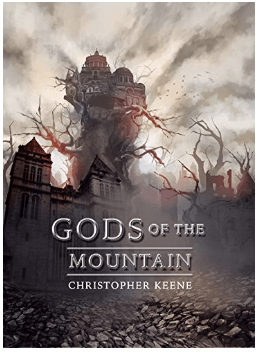
New Book Review 40: Gods of the Mountain

gods of the mountainI’ve been keeping fairly quiet on social media for a while lately, and as an author I’ve been effectively silent for several months. However, I’m still reading plenty and I’m still writing plenty, though not as much as I should be. Any writer would tell you the same, I think. None of us write quite as much as we want to, or we should.

At any rate, what I’m posting here today is the fortieth indie book review on this blog, for the fantasy novel Gods of the Mountain by Christopher Keene, the first (and so far only) book of the Cycle of Blades series. I hope to get a few more reviews here during 2018, but I can’t make any promises right now.

Gods of the Mountain is set in an essentially medieval world, like most fantasy, though there are no magical races or classic mythical creatures here. The setting is the repressive Avaani Empire, where most of our characters live in the major city of Tyria. Near Tyria is the  eponymous mountain, where a religious sect of magic practitioners called the Lunari worship entities called the Ksai, whom they understand as the source of their magical powers. The Lunari are able to use symbols which they hold in their minds to endow themselves with comic-book-like abilities such as flight, strength, speed, teleportation, and others. The Avaani people distrust the Lunari, and the Lunari view the Avaani as a race of godless ignorant blasphemers.

As the action picks up, an Avaani assassin and mercenary named Kessler appears wielding Lunari powers in a quest for revenge against the empire. He is manipulated from the shadows by a mysterious renegade Lunari, and part of his plan is to train up other outlaws in Lunari magic to join him in his quest. Our protagonist is Faulk, an Avaani soldier-turned-mercenary who is unwillingly trained by Kessler and soon becomes a fugitive of the Avaani law enforcement, embodied in the sadistic High Inquisitor Mullen, a bloodthirsty and crafty man who excels in torture and other unkind practices. When the antics of these rogue magic-users attracts the attention of the Lunari, a pair of Lunari come down from the mountain to rein them in, and in the process attempt to recruit Faulk into their sect. Being a godless Avaani, Faulk is skeptical of their tales of Ksai and devotion and heresy. As these and other events unfold, there are revelations and plots and schemes in the world of humans and the world of gods, culminating in an explosive climax.

Gods of the Mountain had its share of strengths and weaknesses. It had an original plot and some new ideas that I hadn’t seen in fantasy before. The way magic worked was entirely its own, although it reminded me some of the novel Elantris by Brandon Sanderson, and I saw that Keene listed Sanderson as one of his influences, so this is not too surprising. The book does well with heightening mystery and intrigue throughout, and in fact we don’t learn the villain’s identity and motivation until near the very end of the novel. One weakness of the book was the indistinct personalities of the some of the characters. A few of the more important characters spoke and acted essentially the same, and that diminished the reading experience some. The book ends on something of a cliffhanger, being the first book of a planned series. This didn’t bother me, but it might bother some readers. Being an adult fantasy novel, the book also has its share of violence, profanity, and sexual content, so more sensitive readers might want to avoid it for those reasons.

All in all, I enjoyed the book and I’d be curious to see what else this author has out there. Fans of fantasy and people looking for books with less conventional plots are likely to appreciate Gods of the Mountain.

And now once again, my bit of advertisement. If you are a fan of fantasy, you can look into my own book, Tales of Cynings Volume I, in print format here or Kindle format here.

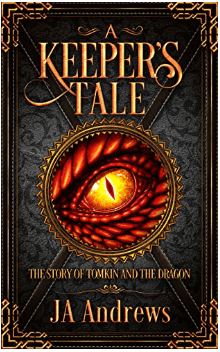
New Book Review 39: A Keeper’s Tale

A Keepers TaleThe thirty-ninth book indie book review I’m doing here is for A Keeper’s Tale: The Story of Tomkin and the Dragon, by J.A. Andrews. Way back in August 2016 I wrote a review for this author’s high fantasy novel A Threat of Shadows, which is one of my favorite indie fantasy novels. If you like, you can find that review here. A Keeper’s Tale is presented as a fable told and retold by people in the world where A Threat of Shadows takes place, and consequently is a little more like a fairy tale than a high fantasy novel.

Our protagonist is Tomkin, the younger and less-favored son of a duke in a dull kingdom called Marshwell. Tomkin is a teenage dork, peevish, too weak to lift a sword, hardly the heroic archetype. He is sent on a quest through two coinciding events: learning that he’s been betrothed to a reputedly shrewish woman, and learning that a dragon has allegedly been devouring local livestock. Before long our brave hero finds himself trapped in a ruined castle alongside a moody dragon named Vorath, a longsuffering kobold named Wink, and a sarcastic young woman whom he calls Mags. The primary plot involves Tomkin’s attempt to escape his predicament, with the supporting characters helping and hindering him in various ways.

Tomkin and Mags are fairly well developed as characters. Thy both have some gaps in their backstories, but they think and act in pretty credible ways. Vorath initially seems like a pretty stereotypical Smaug-esque dragon, but he gets some good development as well. I would have liked to see more development in Wink the kobold, as I was left with a few questions about his personality, motives, and background. That being said, I think it’s to the story’s benefit that there are so few characters. We’re able to get to know those characters without being distracted by keeping track of a wide cast of side characters. Overall I thought characterization was done very well.

For the first half of the novel, everything is pretty light and comedic, and there are notable nods to other mostly light-hearted fantasy works like The Hobbit and Alice’s Adventures in Wonderland. Around the halfway point there is a pretty significant mood shift. Learning more about how Mags and Vorath have come to be in the castle raises the stakes in the story, and it gets to be a little less light-hearted and a little more serious. That being said, the story and Andrews’s writing in general are proudly noblebright fantasy, and the menace stays PG and never quite reaches PG-13 or R. Fantasy fans who favor heavier, grimmer stories might dismiss this more positive fantasy as infantile or pointless, but I appreciate a wide variety of fantasy and thoroughly enjoyed the book. I suppose the target audience might be teenagers and kids rather than adults, but as an adult I liked it, and I think many other fans of the genre would too.

And now once again, the plug. If you are a fan of fantasy, you can look into my own book, Tales of Cynings Volume I, in print format here or Kindle format here.


New Book Review 38: Casting in Stone

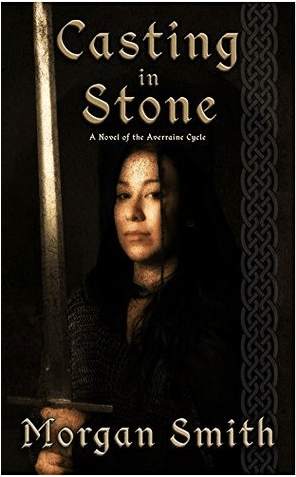
casting in stoneThis is the first new review I’ve done since September. Working as a substitute teacher and maintaining a handful of other jobs have taken up a fair amount of my time, so I haven’t been writing as much or supporting other indie authors as much as I should. That’s not a great excuse, and I mean to do better in the near future.  Now, this latest review (number thirty-eight) is on Morgan Smith’s Casting in Stone. Way back in August 2016 I reviewed Smith’s A Spell in the Country, which is one of the best indie fantasy novels I’ve come across. You can read that review here. Both of these books are in Smith’s high fantasy series The Averraine Cycle, taking place in the same world and referencing some of the same locations and history, but not sharing characters or plot points.

Like A Spell in the Country, Casting in Stone is told from the first person point of view of a tough and fierce warrior, a woman in a medieval-esque land of castles, knights, and dangerous magic. Our hero is Caoimhe, an orphan with notoriously ill luck and a penchant for killing. In a flashback we learn that she served as champion for a young duke named Einon during a period of power struggle and court intrigue in the town of Rhwyn. There were a lot of court intrigues in the story, and I regret to say that I couldn’t very well keep up with all of them. The main story was centered on Caoimhe’s investigation into a curse that she believes has been plaguing her, and the ways that the people around her manipulate her to keep her ignorant of the curse or help guide her to discovering the source of the curse.

There’s some action in the story: descriptions of one-on-one battles between champions, descriptions of skirmishes against feral supernatural wolves, battle against wicked supernatural entities. With the descriptions of fighting and the daily routines of being a soldier in this kind of grim pre-industrial fantasy world, the author spares no detail. The weapons and processes and fighting techniques are elaborated in a way that reveals how much time Smith researched her source material, creating a very believable setting. This was the case in A Spell in the Country as well, and I’m again impressed and inspired by it. In my own fantasy work, I would do well to imitate that commitment to research. That being said, there were long stretches of the book where things moved slowly, and where I really wanted to see more things happening. Where the story was interesting, it was great, but there were stretches when it dragged on.

As someone who appreciates quality high fantasy, I definitely appreciated this book, and I think other fans of the genre will appreciate it as well. I’m keeping an eye out for other works in The Averraine Cycle.

Now, once again, my bit of promo. If you are a fan of fantasy, you can look into my own book, Tales of Cynings Volume I, in print format here or Kindle format here.

New Book Review 33: The General’s Legacy: Inheritance

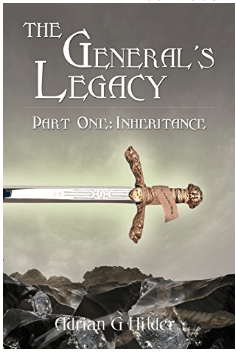
general 1I’ve been taking a break from blogging and reviews for a little while, but I mean to get back into it now. The next book I’m reviewing is The General’s Legacy: Inheritance by Adrian G. Hilder, the first of the ‘General of Valendo’ series. The series (which so far includes just two books) is high/epic fantasy, set in a medieval-style world of kings and knights and wizards.

As explained in the prologue, the land of Valendo is the neighbor and sometimes enemy of the land of Nearhon. The heroic general Garon once fought against the invading people of Nearhon with the aid of the warrior Quain and the mage Zeivite. The opposing country fought using supernatural monsters called Rippers, summoned by a wicked mage named Magnar. Garon and his companions defeated the invaders and brought peace to the land, and the book’s main narrative begins decades later when Nearhon begins showing signs of new aggression. The heroes of the former war are now gray and elderly veterans, training the new generation for the possibility of another war. The main character is Cory, the grandson of Garon, who becomes romantically involved with Julia, the princess of Nearhon, with the hopes of their union helping to keep the peace between their lands. The story sort of crawls along with that plot for a while, until things pick up when Magnar manages to bewitch a prince of Valendo, Pragius, transforming him into a necromancer who raises an army of burning undead skeleton soldiers to conquer Valendo. This is the most prominent use of magic in the book, and for that I suppose a reader might choose to categorize the book as dark fantasy.

I don’t want to give too serious of spoilers for any of my readers who might want to look into this book later, but one peeve I have with this book is its lack of resolution. It ends with a cliffhanger, and for me the narrative arc felt very incomplete. Readers have different opinions about cliffhangers of course, and some readers wouldn’t be bothered by it. The book had a neat premise for me, and that was a strength for it. Lack of originality is an issue I’ve seen with a lot of indie/self-published fantasy, and this particular book had a story that I haven’t seen before, so I was pleased with that.

One persistent issue I had with the book was the way that it used metaphor and personification. It’s good for writing to be descriptive, but this book used a lot of descriptions that didn’t make very much sense and overall diminished the quality of the book.  There were also a fair number of typoes and editing errors throughout the book. Of course, this happens with self-published work and I’m certainly in no position to condemn.

To wrap this up, I’ll say that The General’s Legacy: Inheritance will appeal to fans of the genre, and is a promising first work for a fantasy series. I found it enjoyable.

Now, once again, my bit of promo. If you are a fan of fantasy, you can look into my own book, Tales of Cynings Volume I, in print format here or Kindle format here.

New Book Review 30: Stormwielder

stormwielderThe thirtieth book I’ve reviewing here is Stormwielder, the first of the Sword of Light trilogy by Aaron D. Hodges. Based on the information given about the world in which the book is set, the genre could be epic/high fantasy, but  since this first book was only concerned with a small number of characters and events, I’m more inclined to simply call it medieval fantasy for now.

As we learn in the first chapters of the book, the protagonist is a young man named Eric who is cursed with a magical connection to the weather. Anytime he gets upset or angry, storms and lightning fill the air around him, wreaking havoc. His inability to control prevent this reaction causes an entire city to be burned up by lightning strikes, causing Eric to flee from the vengeful survivors of the city, who believe him to be a demon. As he flees, Eric is aided by an old man named Alistair, who is eventually revealed to be a ‘magicker’ (the term this author uses for characters who might otherwise be called wizards). Alistair mentors Eric in the control and use of his magical powers and guides him through many dangers and perils with the goal, eventually, of saving the world from ominous forces led by the dark lord Archon, who seeks to take control over it.

Now, I will readily admit that this book uses some very common clichés. The teenager whose superpowers make him a danger to others could come right out of an episode of Agents of S.H.I.E.L.D. The wise old wizard mentor has been played out in Gandalf, Obi-Wan Kenobi,  Zeddicus Zu’l Zorander, and so on throughout fantasy culture. The power-hungry magical dark lord has likewise been seen dozens of times in Sauron, Voldemort, Arawn Death-Lord, and others.  Much of the book’s content has been done many times before. However, it did have a few concepts that I hadn’t seen before, such as the particular way that magic works in this world. I can’t explain that here without giving major spoilers, but it was unique.

There were also a lot of typos throughout the work. I’ve come to generally expect that of self-published novels, having spent a year reading them, but it still always irritates me. Apart from that, many aspects of the book’s plot relied on plot twists which I thought came rather abruptly and clumsily. With a good plot twist, the reader can see in retrospect how the story led up to the twist, but with the few plot twists that this book had, I got the impression that they were just dropped into the story without any lead-up. There was also a romantic arc which I didn’t find convincing or necessary, but of course different people will have different preferences about that.

I don’t want to criticize too much though, because I did enjoy the book. As a fan of the fantasy genre, I thought it was a fun read and I’m sure other fans of the genre will think the same. It’s also more light-hearted than something like, say, A Song of Ice and Fire. There wasn’t any profanity, the violence was at times descriptive but still generally PG-13, and there wasn’t any explicit sex. There was implied sex, but not explicit. I think parents could allow their teenage kids to read this book without too much concern.

Now, once again, my bit of promo. If you are a fan of fantasy, you can look into my own book, Tales of Cynings Volume I, in print format here or Kindle format here.
New Book Review 28: The Breath of Aoles

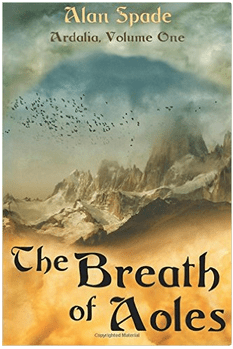
aoles-coverThe next book I’m reviewing in Alan Spade’s The Breath of Aoles, the first book in the Ardalia trilogy. The genre is fantasy, although the other books of the trilogy may expand the world and events to something more like epic or high fantasy. It takes place in a fantasy world of impressive ambition. Most fantasy authors use real-world fauna and flora interspersed with more fantastic and mythological creatures, but in this book every plant and animal was an invention of the author. There was none of the humans and dwarves and elves that we often in fantasy either. The (((SPOILERS IN THIS AND THE NEXT PARAGRAPH)))main character is of a four-fingered three-nostriled species called hevelens, which share their world (which has two moons) with the rock-like krongos race and the telephathic malians.
Our protagonist, Pelmen, is a teenage hevelen who lives a miserable life in the city of Durepeaux, working in his demanding and controlling father’s tannery. When Pelmen runs away, a misadventure with fire-casting sorcerers called crimson shamans brings him back to his city him to live with his bitter old uncle Xuven while attempting to learn the art of hunting. When Pelmen’s friend Teleg disappears under similar circumstances, Pelmen and Xuven assume that he has been kidnapped by crimson shamans as Pelmen nearly was, and they set off on a mission to rescue him. The mission takes them through a variety of places and adventures before they finally reach their destination: a fortress on a volcano, the center of operations for the sinister crimson shamans. (((END SPOILERS)))

If you take this story and you strip away the unique creatures and terrains, it’s a fairly standard journey narrative. We’ve seen protagonists grow and learn over the course of a long journey in hundreds of stories before. Frodo and Samwise do it, Abraham and Sarah do it, Sal Paradise and Dead Moriarty do it, Lolita and Humbert Humbert [*shiver*] do it, it’s very a common theme. This is not necessarily a bad thing. This type of story is popular because it works, as long as it’s written well. This particular book is written well. The mystery and danger of the quest keeps the reader engaged, and the flashiness of the fantastical world keeps the reader interested. It’s a good fantasy novel, unlikely to convert non-fans of the genre but certainly enjoyable for the established devoted.

I do have to remark that the book is slow. There are a handful of exciting bits in the journey, but there is also an awful lot of walking and talking. The author’s creation of unique animals and plants for this book’s world is ambitious, but frequently it was also confusing. When the characters are interacting with their nidepoux and melepeks, their beasts of burden, I don’t know what to visualize. Occasionally descriptions of them would cut off the natural flow of a paragraph, and even with the description I still feel more lost than I would if the characters just uses horses and oxen. There was also a brief romantic arc to the story which seemed, to me at least, out of place. I didn’t think it contributed to the narrative much and overall it didn’t seem very credible. Readers can of course form their own judgments on that.

Overall, I was glad to have read it. I think the novel is a worthwhile contribution to the genre, and the ending left me with enough curiosity that I will probably get the next book in the trilogy (titled Turquoise Water) to see where the adventure goes next.

Now, once again, my bit of promo. If you are a fan of fantasy, you can look into my own book, Tales of Cynings Volume I, in print format here or Kindle format here.


New Book Review 26: The Final Warden

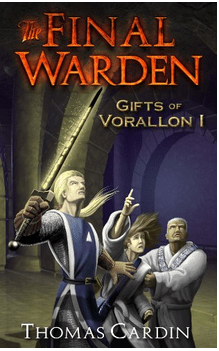
the-final-warden-coverFor my twenty-fifth book review in this blog and first book review of 2017, I’m reviewing The Final Warden, the first book in the epic fantasy series ‘Gifts of Vorallon’ by Thomas Cardin. The world in this book is close to something out of J.R.R. Tolkien or R.A. Salvatore, with humans living in alliance with elves and dwarves while threats to their world manifest in the forms of ogres, trolls, and demons. It’s a familiar epic/high fantasy type of world, but it was well executed here.
The protagonist of the novel is Lorace, a young man who awakes one day with ritualistic scars on his body and no memory of where he’s come from. In this world many people have a particular ‘gift’, which could just as easily be called a ‘power’ or ‘ability’. As the story progresses Lorace discovers his own gift, which he calls ‘sight’, the power to see within his mind places far from his location. In the context of the fictional world these gifts are said to be given by various gods, worshipped by the humans, dwarves, and elves together. Lorace is in possession of a mystical artifact called the godstone, sacred to the gods (naturally). With the aid of humans from the city of Halversome and dwarves from the city of Vlaske K’Brak, Lorace works to recover his memory and discover why it was lost. Along the way he becomes drawn into a war between the peoples of this world and demons from the realm of Nefryt, whose ravages threaten to destroy the world city by city.

The strongest aspect of this story is the quality of its worldbuilding. Within the first few pages, the amount of detail and complexity to the setting blew me away. The details of the world came out naturally, through character interactions and through comfortably brief narrator’s exposition. I was impressed with it, and I hope that I can come close to doing as well in my own work.  The plot was at some points plodding and it took some time to get set up to certain key events, but I wouldn’t say I was bored with it. The book is relatively short, just over 200 pages, so for me it was a quick read overall.

There were several typos throughout the book, such as using “–ing” when “–ed” is meant and misusing apostrophes frequently. Given the overall quality of the rest of the story, this was strange to me. Apart from that, the story ends on something of a cliffhanger. Lorace’s main story arc is completed, but the arc of another character, a demonic entity called the Devourer, is left unresolved. This book is the first of three, so I may well get the next in the series to see what becomes of the Devourer. Cliffhangers are an annoyance to many readers, but the fact that the main arc of the story was resolved satisfied me in this regard.

The last comment I want to make on this book is that it fits one fantasy category that I’ve been hearing a lot about lately: Noblebright. The opposite of GrimDark fantasy, Noblebright is generally positive and optimistic. Heroes are heroic and villains are defeatable. This may make for more predictable storytelling, but it also provides some comfort for many readers who’ve felt lost with the recent trend that’s been popularized by ‘A Game of Thrones’ and its imitators. Fans of Noblebright fantasy and fans of more tradition epic fantasy will enjoy this book, and I’m pleased to say that I did.

Now, once again, my bit of promo. If you are a fan of fantasy, you can look into my own book, Tales of Cynings Volume I, in print format here or Kindle format here.

This post was originally featured on cwbookclub.com.

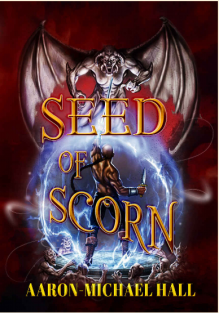
New Book Review 24: Seed of Scorn

seedofscorncover.PNGThe twenty-fourth book I’m reviewing on this blog is Aaron-Michael Hall’s novel Seed of Scorn, the second of her epic fantasy series Rise of Nazil. I reviewed the first of the series, Secret of the Seven, in a previous post which may be read here. As I noted in the earlier review, this series has some representations of sexual assault. Readers who have suffered from traumatic experiences or are sensitive about these subjects should abstain from this series.
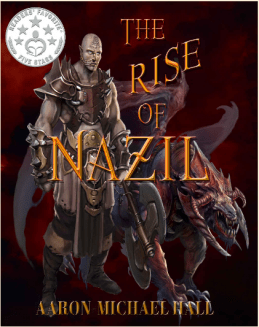
The last book [[[[SPOILERS]]]] concluded with a war to free the land of Faelondul from the tyrannical rule of the city of Nazil, whose inhabitants worshipped fascist gods and treating humans as slaves. The good Nazilian warrior, Pentanimir Benoist, has become the new ruler of Nazil, the seven true gods have revealed themselves to the land, and a new age of peace has apparently begun. As this book begins, unrest is growing among the Nazilians who favored the old order. There is talk of revolt against Pentanimir and restoration of the strict racial hierarchy of the past. In the meantime spiritual enemies of the seven gods are reaching out to make an invasion of Faelondul, pulling hapless Nazilians under their power.  The air is filled with palace intrigue and dark omens.

There is a lot going on and a lot of potential for excitement, but one thing that this book has in common with the previous one is that it moves at a glacial pace. The book is over 500 pages long, well over half of the pagespace is devoted to characters discussing the events of the previous book and characters developing their romantic relationships. In the previous book a lot of space was dedicated to graphic description of torture and rape, and this book has much less of that. It is easier on the stomach, but (and I hate to say this) for long stretches I thought it was kind of boring.

Now, to be clear, the relationships and interactions between characters were quite complex, and written very well. If I was coming to this book with the intent of reading romance, I might be thrilled with this. But, I came to it as a work of epic fantasy. Romance epic fantasy could be a genre that I’m just not familiar with, but if so it seems a very niche group, possibly someplace where fans of George R.R. Martin and fans of Nicholas Sparks overlap. I am a fan of George R.R. Martin, but romance stories bore me. This is not at all to say that the book was badly written, simply that it wasn’t for me.

On the topic of sexual assault, this book had one major deviation from the previous book and from many works of fantasy in general. In the few sexual assaults that happen in this book, the victims are male. It’s a bold move which carries an entirely different set of implications and power dynamics than the alternative, and it moves the plot forward in different ways.

Really, I think this book and this series is likely to be a love-it-or-hate-it affair for most readers. I can imagine other readers loving it. I’ve dedicated a lot of time and effort into getting this far in the series, and I haven’t yet decided if I’ll go on to the third book, Piercing the Darkness. I might, just to see what becomes of the events set up in this one.  Fans of both romance and epic fantasy will enjoy this book, though perhaps not fans of romance and fantasy respectively.

Now as always, my bit of promo. If you liked this book review, you can see my others here: New Book Review 1New Book Review 2New Book Review 3New Book Review 4New Book Review 5New Book Review 6New Book Review 7New Book Review 8New Book Review 9New Book Review 10New Book Review 11New Book Review 12New Book Review 13New Book Review 14New Book Review 15New Book Review 16New Book Review 17New Book Review 18New Book Review 19New Book Review 20New Book Review 21-New Book Review 22New Book Review 23

If you are a fan of fantasy, you can look into my own book, Tales of Cynings Volume I, in print format here or Kindle format here.

This post was originally featured on cwbookclub.com.

New Book Review 19: Secret of the Seven

rise-of-nazil-1The nineteenth book I’m reviewing is Secret of the Seven, the first novel in the series ‘The Rise of Nazil’ by Aaron-Michael Hall. The novel is for the most part high/epic fantasy, with strong overtones of dark fantasy.  On that point, I should give a trigger warning on this review. The book contains a significant amount of rape and sexual violence, and I will speak on that content in this review. Readers who have had traumatic experiences or who are sensitive to those topics may wish to abstain from reading.

In this novel, humans are subject to rule by a race of people called Nazilians, whose capital is the city of Nazil. Nazilian society has ideology close to real-world fascism. They worship of gods embodying War, Power, Courage, and Judgment, and they obsess over racial purity. To them humans are inferior and anyone of mixed human and Nazilian blood is considered an abomination. Many Nazilians are sadistic and use terror as a way to maintain their power. Far from Nazil is the secret city of Bandari, where humans and Nazilians live in peace and harmony. One of the books central characters is Pentanimir, a Nazilian of the rank First Chosen (something like an elite military champion) who falls in love with a human woman, Brahanu. The two characters’ love is one of many pieces in the shifting dynamics of this land, which is moving toward a tipping point past which the cruel reign of Nazil cannot survive. Other pieces include the plotting of the giant Dessalonians who live on the edges of the map, and the awakening of god-like beings called Guardians (the titular Seven) who have their own plans for this world.

Apart from the occasional prophecy, there isn’t much of what we’d call magic in the story until near the end. The world is more closely related to the grit and cruelty that our own societies had during the Middle Ages. The story is strong and engaging, although it has some flaws. It moves along fairly slowly for the first two-thirds or so, setting up the pieces that bring it all to a grand climax in the last third of the book. Much of the time spent setting things up in the first two-thirds was spent on developing the romances between various characters. I’m not opposed to romance stories per se, but in this story they did slow things down quite a lot and I thought much of that aspect could have been shortened. One other aspect that I thought could have been shortened, that of sexual violence, calls for its own paragraph.

Now, I’ve read all five books in George R.R. Martin’s A Song of Ice and Fire (and I am waiting, respectfully and patiently, for The Winds of Winter). That series has gotten criticism for the amount of sexual violence in it. Secret of the Seven has more sexual violence in its 500-odd pages than A Song of Ice and Fire has in its 5,000-odd pages. It’s not left to implication and it’s not left to the imagination. It’s there, on the page, described in graphic and gruesome detail. Slaves of the Nazilians are descriptively raped, repeatedly. Captured enemies are treated to imaginative and meticulously-recounted tortures of sexual nature for dozens and dozens of pages. Every time you think the last of these scenes has passed, another one surprises you. Despite the book’s other strengths, I found this to be in poor taste.  There were times when I strongly considered putting the book aside due to these scenes, but I kept on because I was invested in the characters. So, readers who cannot stomach those kinds of scenes would do well to stay away from this book.

The prose was good for the most part, though there were typos and a handful of parts that could have used a little more editing. However as I said before, the story was good, a strong addition to the fantasy genre. I know there are two others in the series right now, Seed of Scorn and Piercing the Darkness. I will most likely read the former in a few weeks, and if it’s good I’ll go on to the latter. Fans of epic fantasy who are not too put off by gruesome graphicness will probably enjoy this book.

Now as always, my bit of promo. If you liked this book review, you can see my others here: New Book Review 1New Book Review 2New Book Review 3New Book Review 4New Book Review 5New Book Review 6New Book Review 7New Book Review 8New Book Review 9New Book Review 10New Book Review 11New Book Review 12New Book Review 13New Book Review 14New Book Review 15New Book Review 16New Book Review 17New Book Review 18.

If you are a fan of fantasy, you can look into my own book, Tales of Cynings Volume I, in print format here or Kindle format here.


New Book Review 15: A Threat of Shadows

The fifteenth book I’m reviewing (geez, these things just keep going) is A Threat of Shadows, the first of the Keeper Chronicles series by J.A. Andrews. It’s another high fantasy novel, set in a medieval world populated by humans, dwarves, elves, dragons, wizards, and various mystical monsters. It also has the distinction of being, so far, the best indie novel I’ve read.

The protagonist’s hero and protagonist is Alaric, whose occupation as a Keeper enables him to have various magical abilities and a wide range of arcane knowledge. When Alaric’s wife Evangeline is bitten by a poisonous snake he embarks on a quest to find an antidote for her, which puts him in the path of a plot to resurrect a long-dead wizard of a wicked group called Shade Seekers.

In many ways the novel seems to follow several fantasy tropes that have been used to the point of cliché. Alaric is a quest in a traditional fantasy land, and he eventually becomes part of a traveling party with an old wizard, a gruff dwarf, an ethereal elf, a blacksmith, and a milkmaid. That trope, the diverse wandering fellowship, has been done many times before. However, without going too far into spoilers, this book turns the trope on its head in an unexpected and spectacular way. I’m always impressed by writers who can take the familiar aspects of a genre and do something new with them, and A Threat of Shadows does that especially well.

A major part of the book’s appeal for me was that it had a sense of wonder to it. I’ve noticed a trend with a lot of recent fantasy that the books sometimes take themselves very seriously. A Song of Ice and Fire, despite all that’s good about it, doesn’t have that sense of wonder. I don’t think the indie fantasy novels I’ve previously reviewed on this blog had it either. Books with a sense of wonder don’t try so hard to be gritty or realistic. They allow themselves to be playful, to do impossible things because impossible things are fun. The Harry Potter series is an especially prominent example of this. So is Piers Anthony’s A Spell for Chameleon of the Magic of Xanth series, but I strongly disliked that one for other reasons. Many fantasy novels written for children or young adults have that playfulness. I would not say that A Threat of Shadows is aimed at children or young adults (though it doesn’t have anything that would lead most parents to prohibit it), but it still has that playfulness and wonder.

A side-effect of that playfulness and wonder is that the characters occasionally benefited from having just a little too much luck in their quest (which, as the story progresses, shifts from healing Evangeline’s wife to preventing the return of the villainous wizard). In another book this might bother me, but in this case I’m okay with it.  The writing was also very good, mostly without any grammatical or formatting mistakes.

To wrap this up, I would definitely recommend this book to fans of fantasy. If you’re into anything from J.K. Rowling, J.R.R. Tolkien, George R.R. Martin, Terry Pratchett, and so on, you’ll most likely enjoy this book.

And now once again, the plug. If you liked this book review, you can see my others here: New Book Review 1New Book Review 2New Book Review 3New Book Review 4New Book Review 5New Book Review 6New Book Review 7New Book Review 8New Book Review 9New Book Review 10New Book Review 11New Book Review 12New Book Review 13New Book Review 14

If you are a fan of fantasy, you can look into my own book, Tales of Cynings Volume I, in print format here or Kindle format here.