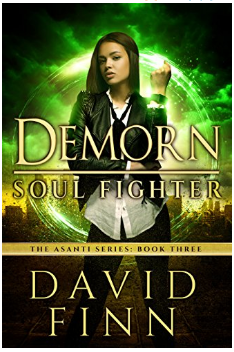
New Book Review 36: Demorn: Soul Fighter

demorn 3The next indie book review I’m doing is for David Finn’s sci-fi fantasy space opera all-around actionfest, Demorn: Soul Fighter. This is the third book of the Demorn series, and I reviewed the first and second of them last year. Those reviews can be found here and here.

As a quick refresher on the premise, Demorn, the Wandering Princess of Swords, is a witty (and sometimes nihilistic) young woman who has time-travelled, space-travelled, and dimension-travelled throughout a multiverse that’s crumbling under the weight of imminent cosmic calamity. She is an extraordinary fighter, making use of guns, fists, a supernatural flaming katana, and a variety of magical objects gifted to her by gods and other entities in her wide and varied travels. She has been a priestess, arena fighter, and presently a mercenary. She also really loves comic books, and is good friends with Frank Sinatra, who happens to be a leader in a resistance against cosmic baddies.

Each of the Demorn books has had a common difficulty. In their freneticism and dimension-jumping and panache, they are confusing as hell. They’re all packed with action which is so well-written and so detailed that it’s a beauty to read, but keeping track of the plot is always challenging. In Soul Fighter, a catastrophe called the Fracture Event has torn apart the multiverse, erasing past timelines and sending beings from one dimension into another, wreaking all kinds of havoc. Members of a cultish organization called the Triton Corporation initiated the Fracture Event for diabolical purposes involving wicked cosmic gods (fans of H.P. Lovecraft will recognize the concept). Demorn starts in a Las Vegas-like metropolis called Bay City, where she competes in Soul Fight tournaments. Each fighter carries several mystical skulls which contain a soul, enabling them to fight and die multiple times. The loser of a fight has their soul-skulls taken away by a Death Banker, shadowing persons with their own motives and allegiances. From this setting, Demorn turns from gladiator to assassin to hunt down one Death Banker who means to release a cross-dimensional plague on the city. This sets her on a path to encounter an old friend and sometimes enemy, Iverson, an operative and detective-like character with whom she embarks on a quest to find the Reset Pyramid, which will enable them to reset time and avert the Fracture Event. Along the way they encounter former friends and rivals and lovers (Demorn, I nearly forgot to mention, is a lesbian), including Demorn’s brother Smile, her former co-priestess Toxis, her former lover Winter, the powerful warriors Wolf and Wrecking Ball, and the white-collar foes within the Triton Corporation. This book also has a brief appendix to help keep track of all the characters, factions, and magical items in the series.

I can’t stress enough that despite how confusing these books are, I love them. Each of them has been an incredibly fun read, and I’d highly recommend them for fans of sci-fi and fantasy.  Reflecting on the way the stories work, I see a lot of influence from comic books especially. With the variety of worlds and scenarios and the vivid descriptions, I’ve wondered if the books might be enriched if they were in fact graphic novels instead of prose novels. If the author ever does make a graphic novel of the series, I would be excited to read it, and I certainly look forward to the release of the fourth book in the series, titled Demorn: Ultimate Fate.

Now, once again, my bit of promo. If you are a fan of fantasy, you can look into my own book, Tales of Cynings Volume I, in print format here or Kindle format here.

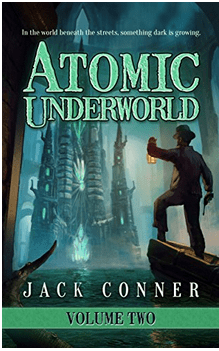
New Book Review 27: Atomic Underworld: Part Two

atomic-underworld-2-coverThe twenty-seventh book I’m reviewing here is Atomic Underworld: Volume Two, by Jack Conner. This book is the sequel to one I reviewed a few months ago, Atomic Underworld: Part One. That review may be read here. Within the same world this author also has the Atomic Sea series and the books Nightmare City and City of Shadows.

A quick recap of the setting: the story takes place in and around the subterranean city of Muscud, which sits over the highly toxic Atomic Sea. In this alternate world technology has developed in a steampunk-like direction, and humans share the city with various pre-human alien species and with humans afflicted by the mutating effects of the sea. Rival gangs hold the most power in the city, but power also belongs to the cultists who worship various otherworldly gods. In the last book, our hero Tavlin “Two-Bit” Metzler, a gambler and thief and all-around rogue, was captured by cultists and brought to the temple of their god, Magoth. This second part to the story begins with Tavlin’s captivity and brainwashing in their temple. Other characters working with and against Tavlin include his ex-wife Sofia, friend and brutal mob boss Vassas, rival mob boss and cultist Havictus, the cult leader known only as the Lady, and a ghostly woman of ambiguous allegiance named Millicent.

As noted in the review of the previous book, the strongest feature of these books (probably of all Conner’s work) is the detail. The stinking, toxic, moist underworld that he paints feels stinky and toxic and moist. The description is vivid and graphic, and I really appreciated that. The characters are in some ways a little cookie-cutter (Boss Vassas is every cigar-chomping mob boss ever, Tavlin is right out of the Han Solo/Jack Sparrow/Malcolm Reynolds school for likable outlaws, all of the gangsters are noir characters with superficial mutations), but they’re fun anyway. Now, as I said, I read the previous book a few months ago, so I generally remembered who the characters are, good guys and bad guys and whatnot, but I couldn’t really remember which slimy jiggly pre-human alien race was which, and the sequel didn’t really take any time to recap those details. The story goes straight forward where the last book ended, with no recaps at all. For this reason, I wonder why the two books are in separate volumes at all. I’m aware that the author also released an Omnibus Edition with both books included, but why not just have them together as one novel? I can guess, but I prefer not to be cynical and to instead hope that the reason was creative.

For anyone who wishes to read these stories, the genre needs to be well understood. These are pulpy action stories. They take some inspiration from the horror tales of H.P. Lovecraft, but they are not horror. The purpose of these stories is to entertain, and in that capacity they deliver. A small advisory warning: the book contains a lot of graphic violence, some references to rape, and one descriptive sex scene. Some more sensitive readers might be put off by these features, though I personally was not. I found both of these books fully entertaining, and I expect if I read other work by this author I will encounter the same. The conclusion especially, the climactic fight scene that resolved the story, was especially satisfying. Fans of action and crime stories, dark fantasy, and horror/pulp fiction are the recommended audience for these books. As a fan of science fiction and fantasy, I loved them.

Now, once again, my bit of promo. If you are a fan of fantasy, you can look into my own book, Tales of Cynings Volume I, in print format here or Kindle format here.
This post was originally featured on cwbookclub.com.

New Book Review 23: Cthulhu Armageddon

cthThe twenty-third book I’m reviewing on this blog is Cthulhu Armageddon by C.T. Phipps. It’s billed as a post-apocalyptic western, but I’d say calling it a western is a stretch. It’s a fantasy action thriller set in a desert wasteland, conceptually closer to a story like Mad Max than a story like The Good, the Bad, and the Ugly.
To really have context for this novel, you need at least a cursory knowledge of the works of H.P. Lovecraft, whose popular stories include The Call of Cthulhu, The Dunwich Horror, and my personal favorite The Case of Charles Dexter Ward. Lovecraft stories and mythos contain the idea that in the sea, underground, and in the far reaches of space are monstrous alien gods who will someday return to power and destroy humanity. Cthulhu Armageddon is a post-apocalyptic action novel based around the idea that in the future, Lovecraft’s gods and monsters (his specific gods and monsters, here with the same names and aspects that they have in Lovecraft’s works) have risen and wreaked havoc upon the earth. Their ravages have turned the world into a hellish place, where the surviving “civilized” humans fight for survival alongside rabid cultists, mutant monsters, and the terrible gods themselves.

Our protagonist, John Henry Booth, is one of the surviving humans in a group called the Remnant.  He is a trained and tenacious soldier who struggles through shaky alliances and bitter enmities with monsters and humans in his quest for revenge against the mad wizard Doctor Alan Ward, a former scientist who believes the only way to survive with the gods is to become as monstrous as them. By his side throughout the story is his mutant friend Richard, cultist and former lover Katryn, his teammate Jessica, a professional torturer named Mercury, and a wide-eyed little girl named Jackie who’s seen entirely too much brutality for her age.

This isn’t the first brutish post-apocalyptic novel I’ve reviewed on this blog, but within that genre I think this is the best one. The premise may sound schlocky, a little too close to fan-fic perhaps (not that there’s anything wrong with that, but it does have a poor reputation), but the quality of the writing here is impressive. For the most part it’s smooth, well-paced, and strikingly professional. Especially excellent were the book’s action scenes, of which there were many. These were simply incredible. Some of the characters were a little clichéd, a little stereotyped post-apocalyptic warrior, but the central characters had a lot of depth and wisdom to them, much more than you would expect in an action adventure like this.

There are a few places in the book where a sentence was confusingly structured or where the wrong word was used (‘grizzly’ when the author meant ‘grisly’, for example), but these were rare and the book’s strength far outweigh this small weakness. It is also worth noting that while this book takes ideas and personages from Lovecraft, it is not meant to be modeled on Lovecraft’s work. In Lovecraft, the atmosphere is full of dread and existential horror, carried forward and permeating the narrative through the terror, disgust, or madness of the characters. The characters in Cthulhu Armageddon do have terror and disgust and madness, but they also have humor and love and jealousy and anger.  They crack wise while they crack skulls, and frequently they spit in the face of death as opposed to cowering like a Lovecraft character would. This isn’t a horror novel. It’s an action adventure fantasy novel, and it’s a thoroughly enjoyable one.

For potential readers, it is worth noting that the book has profanity and sex and (if this post hasn’t already made it clear) lots and lots of pulpy violence, so it’s not recommended to sensitive readers. I got a lot of fun out of it, and can definitely recommend it to fans of action, sci-fi, and especially the weird tales of H.P. Lovecraft.

Now as always, my bit of promo. If you liked this book review, you can see my others here: New Book Review 1New Book Review 2New Book Review 3New Book Review 4New Book Review 5New Book Review 6New Book Review 7New Book Review 8New Book Review 9New Book Review 10New Book Review 11New Book Review 12New Book Review 13New Book Review 14New Book Review 15New Book Review 16New Book Review 17New Book Review 18New Book Review 19New Book Review 20New Book Review 21-New Book Review 22

If you are a fan of fantasy, you can look into my own book, Tales of Cynings Volume I, in print format here or Kindle format here.

This post was originally featured on cwbookclub.com.

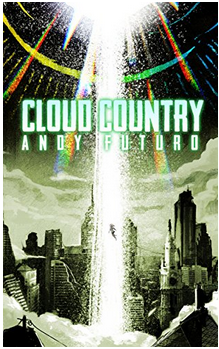
New Book Review 18: Cloud Country

cloud-country The eighteenth book I’ll review here is Cloud Country, the second part of the Special Sin series by Andy Futuro. I reviewed the first book, No Dogs in Philly, in a previous blog post that you can read here. The series is a mix of cyberpunk, noir, dark fantasy, and Lovecraftian horror and follows a detective named Saru, a woman who fights crime in a gritty alternative version of Philadelphia. Her world includes brain-implanted internet streams, feuding cults, stray zombie-like creatures called elzi, and most importantly the conflicts between rival alien gods who see humans in a way much like humans see microbial cells. The story starts with her in the center of the devastation wrought by the events of the previous book and takes her through a new series of dangers, exploits, and revelations.

The first book was really fast-paced, and in comparison this second one is pretty slow. It centers on Saru and a Gaesporan (a member of the hive-mind-ish social elite) named John, and a lot of pagetime is spent explaining mysteries that came up in the first book and explaining the rules of this world. In the first book the supernatural implications of the events were initially unknown and Saru uncovered them little by little. Here we receive long detailed explanations of how things are and why they are the way they are. It was a bit heavy on exposition because of this. John knows the answers to all of Saru’s questions, and he explains these answers in long stretches of dialogue. The moments of action were fewer and more spaced out than in the first, but this didn’t bother me. I expect that at least one more book in the series is forthcoming, and it will benefit from having the world laid out more clearly.

One of this work’s main strengths is Saru’s narrative voice. She’s an extreme character, but she is consistent in her extremeness and her voice and attitude fits her personality. Here we see her less as a fighter and detective and more as a lost and fugitive young woman, a facet of her personality which existed in the first book but took a backseat to her hard-boiled-detective shtick. We get to know her better here, we see more of her weaknesses and insecurities. This comes in a large part from her being removed from her comfort zone, that is to say the crime-ridden alt-reality Philadelphia. In this book she spends more time in differing places and trapped inside her own memories, which uproots her and sets her in a more abstract kind of world. Due to this, the crime aspect and the cyberpunk aspect of the first book are largely discarded.

At this time there isn’t a third book in the series, and I haven’t seen any announcements for one yet. Nonetheless, I expect that there will be a third, and I look forward to it. As I said before, I enjoy this series and I’d recommend it to others. Of course, it features mature themes and isn’t for children or especially sensitive readers. It’s horror, after all. If you pick up a book of horror fiction you know what you’re getting into.

Now as always, my bit of promo. If you liked this book review, you can see my others here: New Book Review 1New Book Review 2New Book Review 3New Book Review 4New Book Review 5New Book Review 6New Book Review 7New Book Review 8New Book Review 9New Book Review 10New Book Review 11New Book Review 12New Book Review 13New Book Review 14New Book Review 15New Book Review 16New Book Review 17

If you are a fan of fantasy, you can look into my own book, Tales of Cynings Volume I, in print format here or Kindle format here.

New Book Review 16: Atomic Underworld: Part One

The sixteenth book I’m reviewing is Atomic Underworld: Part One by Jack Conner, the first of the ‘Atomic Underworld’ duology, which itself is a prequel to Jack Conner’s ‘Atomic Sea’ series. The book is billed as Lovecraftian steampunk fantasy, which is to say that it takes inspiration from the otherworldly horror stories of H.P. Lovecraft and the speculative alternative history of steampunk sci-fi. In its execution I would also add ‘noir’ or ‘mystery’ to the genre. It’s a good mix, and the various pieces work well together.

The story’s protagonist is Tavlin ‘Two-Bit’ Metzler, a professional gambler and general rouge living in the subterranean city of Muscud, on the banks of the Atomic Sea. This city is one of several underground cities primarily inhabited by mutated humans, but also inhabited by ordinary uninfected humans, mutated animals, and members of various sentient pre-human species (some rather slug-like, some blob-like, and some arthropod-like). These cities are in the sewers of the larger metropolises above ground, and their primary authorities are multiple religious cults and various rival gangs. When Tavlin’s old friend and full-time mob boss Vassas has several members of his gang die under strange circumstances, Tavlin is asked to investigate. His investigations put him in the middle of a dangerous adventure centering on a strange weapon which the cults and sentient pre-humans are all desperate to get their hands (or tentacles) on.

The best thing about this book was its incredible level of description and texture. Muscud and the cities near it are disgusting places. They’re slimy, they stink, everything is damp and crawling and infected, and the descriptions are written with skin-crawling vividness. All of the mutant creatures, all of the alien-like underworld denizens, were described excellently. The quality of the writing was also very good, with few errors. I did feel like the characters drew heavily from crime-drama clichés, but that’s not so terrible. These kinds of characters are used because they’re effective. Maybe we’ve all seen movies with some fedora-wearing cigar-chomping pistol-waving mob boss shouting profanities before, but that doesn’t diminish the character’s entertainment value.

The book was heavy on action, with chases and gunfights familiar to anyone who’s read or watched any kind of mystery or crime dramas. The difference of course is that these fights are here taking place in a slimy underground city, which allows for some different approaches. The fights were well-written as well, however due to the way the story uses them, I would dispute the book’s Lovecraftian label. In a Lovecraft story, there is always a sort of creeping dread pervading the narrative. The characters in a Lovecraft story are victims of hellish otherworldly forces gradually driving them into unspeakable terror and insanity through the influence of eldritch alien gods. In Atomic Underworld, there are (or at least seem to be) eldritch alien gods , and there is dread, but the dread doesn’t pervade the narrative. The book doesn’t feel like a horror story. With a cocky rogue for a protagonist and with mobsters out of a 1940s noir film chasing each other through an urban jungle, the book feels more like action/adventure than it does horror. This isn’t a bad thing, but it is worth noting. It’s also worth noting that this book ends on a complete cliffhanger, which may annoy some readers.

On the whole, I enjoyed it. The detail was impressive and the story was engaging, and the odds are good that I’ll buy and read the second part of it.

And now once again, the plug. If you liked this book review, you can see my others here: New Book Review 1New Book Review 2New Book Review 3New Book Review 4New Book Review 5New Book Review 6New Book Review 7New Book Review 8New Book Review 9New Book Review 10New Book Review 11New Book Review 12New Book Review 13New Book Review 14New Book Review 15

If you are a fan of fantasy, you can look into my own book, Tales of Cynings Volume I, in print format here or Kindle format here.

New Book Review 7: GrimNoir

The seventh book I’m reviewing is GrimNoir, a collection of seven short stories by Kevin Wright. Each of these stories is different, and while the genres of fantasy, epistolary,  detective, and steampunk were all present, the genre appearing in each story was horror. These are primarily horror stories.

Writing a review for this book without going into the strengths and weaknesses of each individual story is difficult, especially since there was so much diversity to this book. The characters of each story have different personalities and different values, the themes are wildly different, even the style of writing is wildly different. I do not know Kevin Wright personally, but I assume that the stories he put into this book were written at different times, perhaps at different stages of his growth as a writer. Some of the stories had a more mature feeling to them than others, but I am speculating. The nature of the horror varied from story to story. In some of them it was supernatural horror, the work of spiritual forces left deliberately mysterious. In others, the horror was in the bitter realities of human behavior, consequences of the vicious selfishness humans will resort to when struggling to survive. This was very well done.

One other unifying factor to these stories was, as the book’s title suggests, they are grim. They are unrelentingly grim. Through the first four stories, I was wishing for some comic relief, something to give contrast to all of the blood and fear and vindictiveness of the book. The fifth story, in which a poor boy in a medieval setting must go through with a duel against a noble whom he insulted while drunk, gave that comic relief. This story is quite grim in its conclusion as well, and it was the only story with comedy in it. There’s nothing wrong with the book being unrelentingly grim, but readers who are turned off by those kinds of stories will not enjoy this book. They are not the book’s target audience. The book’s target audience, I think, will love it.

The style and quality of the writing vary from story to story. In the first two, I was impressed with how tight and clean the prose was, but I was also put off a little by the frequent use of repeated two-word sentences for dramatic effect. This device was abandoned in after the second story, and following that the writing was for the most part excellent. The final story, ‘The Brazil Business’, is written as a series of letters between brothers in Massachusetts and Brazil during the 1930s, and the writing of those letters was very nearly flawless.

‘The Brazil Business’ was in my opinion the best story in the book, and it read almost like a pastiche of H.P. Lovecraft (of whom I have read ‘The Call of Cthulhu’ and a long anthology titled The Thing on the Doorstep and Other Weird Tales). This is, for the most part, a good thing. The horror was well-executed, the descriptions were perfect, and the characters were quite believable. The only potential trouble I saw with the story was that the Lovecraftian characters and Lovecraftian setting also carried the racial ideas that permeate Lovecraft’s work. I wasn’t overly bothered by this, but I recognized that it was there, and I recognize that other readers might be bothered by it.

Overall, GrimNoir excelled as a horror anthology. I would recommend it to anybody who likes horror fiction.

Now, the plug. If you liked this book review, you can see my others here:

New Book Review 1New Book Review 2New Book Review 3New Book Review 4

New Book Review 5New Book Review 6New Book Review 7New Book Review 8

As a final note, my book of fantasy novellas, Tales of Cynings Volume I, will be available for just 99 cents on Kindle from June 12 to June 18. I am of course biased, but I recommend it to readers who like fantasy.

New Book Review 6: No Dogs in Philly

The sixth book I’m reviewing is No Dogs in Philly, the first book of the ‘Special Sin’ series by Andy Futuro. It’s written as a mix of genres, with cyberpunk, dystopian, Lovecraftian horror, and crime noir all represented in the story.  This is definitely one of the best indie books I’ve read, and I’d definitely recommend it to other readers.

The protagonist is a woman named Saru, a detective working in a future version of Philadelphia. In this world, most people have brain implants that allow them to have continuous internet access inside their brains (side-affects include getting your entire perception of reality taken over by hackers). The highest level of society is the Gaespora, alien-ish beings who are more or less benevolent but whose motives deliberately unclear. Somebody in Philadelphia is murdering girls with blue eyes, and the Gaespora put Saru on a case to protect one particular girl, Ria, a young woman who goes through her life protected by a dog-like entity who only she can see. As the story goes on, we learn of divine-ish forces controlling the all of the events, a concept fitting with the Lovecraftian horror concept of the story (the works of early 20th century horror writer H.P. Lovecraft featured god-like otherworldly beings who are either indifferent or antagonistic to our world).

It’s a pretty wild premise. The world of the story is dark and gritty as any noir story, with the addition of monstrous otherworldly threats lurking in the landscape. All of these different genres could clash with one another in really ugly ways, but in fact I was thoroughly impressed with how well the author blended them. In the world that he’s made, everything fits in. Every hallucination, every death-cult, every drinking binge from the protagonist, not one of these elements feels out of place.

The story does jump around some between points of view, and certain aspects of the story were deliberately mysterious for so long that I never really felt that I fully grasped everything that was going on. This may be a book that benefits from being read at least twice, as there were times when I felt really lost. This was not a matter of sloppy craftsmanship though. The pieces were all there. They were just difficult to understand in the first read.

Apart from the excellent crafting of the world, the story’s writing was superb. The sentences were clean and professional. The editing was for the most part flawless. I say “for the most part” because there were a handful of word choices which I found unusual. The author had a strange fondness for the word “tits” which never really made sense to me. It was very distracting. The rest of the writing was good enough that I’m willing to overlook the overuse of that word.

As I said before, I would definitely recommend this book. There is violence and profanity and horror themes, so readers who are sensitive to those things probably wouldn’t enjoy it, but I think fans of science fiction, horror, and crime fiction would enjoy it quite a lot. I certainly did. Andy Futuro published a sequel earlier this year, Cloud Country, which I will probably buy and review later.

Now, the plug. If you liked this book review, you can see my others here:

New Book Review 1New Book Review 2New Book Review 3New Book Review 4

New Book Review 5New Book Review 6New Book Review 7New Book Review 8

If you are a fan of fantasy, you can look into my own book, Tales of Cynings Volume I, in print format here or Kindle format here.