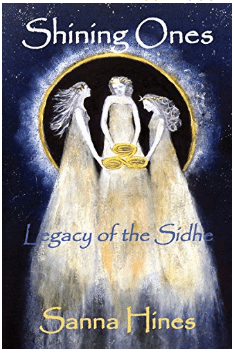
New Book Review 32: Shining Ones: Legacy of the Sidhe

shining-onesThe next book I’m reviewing here is Shining Ones: Legacy of the Sidhe, a modern fantasy novel by Sanna Hines. The book takes place in the 21st century, primarily in Ireland, Wales, and Scotland, and draws heavily on the legend and mythology of that part of the world for its fantasy elements.

In the book’s backstory, the magical races of the Danann and the Formorians have been at war for centuries, a war which has taken place over a few different parallel dimensions and which has employed magical weapons and strategies which have shown up in our world’s mythologies in various ways. Characters such as Merlin (of the Arthurian legends) and Finn Mac Cool (of Irish legend) were and still are immortal players in this conflict, and legendary items such as the sword Excalibur and the Four Treasures of Dagda (Sword, Spear, Cauldron, and Stone) have all played roles in this conflict. I’m not especially familiar with this particular area of mythology, but I can imagine somebody else really geeking out over it.

The story gets set into motion when a teenage girl named Lia is kidnapped by Formorians, who have plans to use her in their quest to discover the secret behind Danann immortality. Lia’s father, Sam, has to set out on a quest to save her, with the help of the Danann woman Tessa, her nephew Cory, a dog named Cu, and several other characters who all have some connection with the ongoing conflict. Tied up in all of this are teleportation portals, ancient temples, and a ritual involving the alignment of three asteroids in the shape of the mystical triskelion symbol.

I recognize that this book’s worldbuilding is excellent. It created a believable and detailed world by merging together disparate mythologies, real-world geography, and science. I was impressed with this. That being said, I had a lot of difficulty keeping track of who the characters were. I know that some were ordinary humans and some were of the magical races, but in terms of the way they interacted with each other, they weren’t very distinct. In the final quarter of the book some of the mysteries about the different characters’ pasts and connections were revealed, and in that section I was able to see clearly how the characters were different, how their different backgrounds had led them to play the role that each had played in the story. But, there were at least a dozen other characters besides those I’ve named here who all were important yet indistinct until the last quarter, and this was a problem for me. Having finished the book, I feel like if I reread it knowing the ending I would be able to get more out of it, and appreciate the story more.

Overall, it was an enjoyable (if confusing) read, a fantasy work not quite like any that I’d read before. I should note, though, that the book is written for adults, not children. It does have some profanity and a fair amount of strong sexual innuendo and implied (if not totally descriptive) sex scenes which most parents probably wouldn’t want their children or young teenagers reading.

Now, once again, my bit of promo. If you are a fan of fantasy, you can look into my own book, Tales of Cynings Volume I, in print format here or Kindle format here.

As a final note, I might not be able to post reviews to this blog as frequently as before, as I’m working a lot now and devoting a lot of time to writing my second book, Tales of Cynings Volume II. Reviews here may come every two weeks, or even less often.
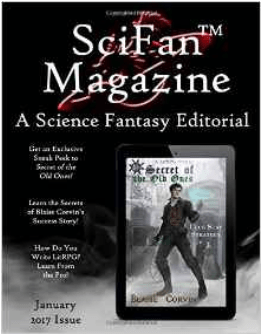
New Book Review 29: SciFan Magazine January 2017

scifanThe next book review I’m doing is a little different than the previous ones. I’m reviewing the January 2017 edition of SciFan Magazine, a monthly digital magazine designed to showcase current and upcoming independent authors. The editor is Richard M. Mulder, whose work I hope to review at a later date. There were thirteen stories/excerpts in the magazine, and I will address each of them here.
The first, ‘Octov’s Rise to Ainoren’ by Dawn Chapman, is an excerpt from the novel The Secret King: Lethao, which I reviewed on this blog here. Chapman’s work is excellently written, with strong detail and description and otherworldly characters who are familiar enough for the reader to empathize, yet whose otherworldly attributes and powers create a sense of wonder while reading.  This particular excerpt is full of action and intrigue, and I liked it.

The second, ‘Séance on Death Row’ by Douglas Kolacki, is a short horror story in which a group of people, including a murderer, hold a séance to speak with the murderer’s victim. It was an older style of horror, relying heavily on implication and imagination, with dread permeating the story and with the horror stemming from forces beyond the grave which may be seen but not fully understood. It reminded me of Edgar Alan Poe’s work. I liked it.

The third, ‘The Tot of Wonder’ by John Taloni, is a much more lighthearted and goofy tale of a superhero father who lives with his non-super wife and his super-powered toddler son.  There’s not a whole lot to it, but I think it’s geared more toward a young audience. It felt a little out of place in this magazine, but as a work for children I suppose it’s fine.

The fourth, ‘Miss Soames’ by Kyle Hemmings, was an odd one. I can’t say much about it without completely spoiling the story, but I didn’t like it very much. The prose was okay, but the plot was kind of nonsensical, a sort of bait-and-switch horror story that was so busy trying to surprise the reader that it forgot to be scary.

The fifth, ‘Orlok’s Song’ by David Castlewitz, was my favorite in the magazine. In this short story, there is a sentient species called the Peet (animal-like beings) who have been driven from their forest homes by human enterprise. Orlok is the father of a family that tries to survive in the new concrete forest of city slums. The writing in it was beautiful, and the story was brief but excellent in its narrative and conclusion. I’d definitely recommend this one.

The sixth, ‘Voices Beneath the Ice’ by Matthew McKiernan, is a sci-fi story with horror elements involving a trio of astronauts who land on Europa (a moon of Jupiter) and begin to find strange reasons to hate each other. I liked the concept a lot, but some of the prose needed work. I think this story has a lot of potential, and could be really great if some more time was given to it.

The seventh in the magazine is an excerpt from the book Secret of the Old Ones by Blaise Corvin. Its genre is given as LitRPG Sci-Fan™, in which the real world and the world of gaming are both important to the narrative. The only issue I have with the excerpt is that the character never seemed to really be in danger, but since it’s just an excerpt of a larger work, I’m sure there will be more conflict and excitement later in the story. I really liked this excerpt, and I’ll probably read the book at some point.

The eight is also an excerpt, titled ‘The Stirring’ by Jaren Fleming. It was something like Christian creationist science fiction, about a planet that serves God (here called The Father) at war with gooey alien beings that serve Satan. The whole excerpt was nothing but combat, and the writing was good, but  I hope there is character development and more fleshing-out of the story in the larger work. I wasn’t a huge fan of the premise, but I can imagine other people liking it quite a lot.

The ninth was ‘Stormguard: The Invisible War’ by Tom Fallwell. It was another case of Christian-themed action sci-fi. I can’t say much about it without spoiling the whole story, but it starts with a man waking up in a crater with no memory of who he is or where he came from. The writing was okay, but I thought the premise was kind of a cliché. This was an excerpt of a larger work as well, but I probably won’t seek out the larger work.

The tenth, ‘Spacejacking’ by Russell Hemmell, seems like it may be an excerpt from a larger work, but it was unclear to me. It’s a futuristic tale of an alien abduction during space exploration, and the subsequent consequences. Again, I can’t say a lot without giving away the entire story, but I liked this one. It had some interesting and unusual ideas in it, and if it is part of a larger work I’d like to see where the story goes.

The eleventh story, ‘The Brat and the Other Country’ by David Perlmutter, was a real oddball. The premise was similar to the film ‘Who Framed Roger Rabbit?’, if that film was a story about superheroes rather than a detective story. In the story, the cartoon characters of Earth actually live on another planet, and the main character is a superhero human who works alongside superhero cartoon characters. I can imagine other people really loving the premise, but it was just a bit too much of a stretch for me.

The twelfth story, ‘In the Hot Mists’ by John A. Frochio, is a steampunk tale about an airship race in which one airship has an unfair advantage because it’s crewed by extraterrestrials. Strange as this premise is, I liked it. The writing was good, it put a new spin on a familiar story, and I think lots of other people would enjoy the story too.

The last story (good job for sticking with me this long!) is ‘The Keystone Islands: Portals of the Grave’ by Lander Allen. It’s the first three chapters of a larger work, a soft sci-fi work set in a universe where Earth is a cultural center resented by the other planets. The tetrapath infection turning its victims into horrific monsters, and the protagonists have come from who-knows-where and are trying to figure out their past in the midst of this plague. It’s well-written and very intriguing, and I’d like to see where the story goes.

So, those are the thirteen stories from the January 2017 edition. I expect to review later editions of the magazine in this blog as well, as it seems like a great way to see at a glance what’s going on in the indie fantasy and sci-fi community.

Now, once again, my bit of promo. If you are a fan of fantasy, you can look into my own book, Tales of Cynings Volume I, in print format here or Kindle format here.

New Book Review 25: Feeder

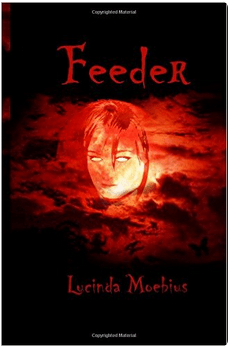
feeder-coverThe twenty-fifth book I’ll review in this blog is the modern/urban fantasy novel Feeder, by Lucinda Hawks Moebius. Lucinda has been extremely supportive of the online independent author community and devotes a tremendous amount of effort and energy to it, so I’m happy to give her some support back. This novel could be categorized as horror, but I hesitate to call it that because it didn’t seem to be written with the intent of scaring the reader. But of course, as with any book, another reader may view it differently.

The protagonist and narrator of this novel, Maria Christine, is known as a Were, or a Feeder, soul-eater, vampire, demon, etc. Different cultures give different names to her species. Members of her species call themselves Were, and within her species there are different types of Were with different attributes and abilities. The greatest similarity between all Were is the need to feed upon the life energy (that is to say souls, more or less) of living humans. For better or worse, Feeder is a vampire novel. This might be off-putting for a lot of readers, but as they say you shouldn’t judge a book by its genre (well, they say something like that). Every author who takes on the vampire concept puts their own spin on it, and this author is no exception. Rest assured, this book isn’t just a carbon copy of Twilight (thank goodness). Nobody sparkles, nobody is especially attractive, and in fact it’s quite a bit more brutal and gritty than many other vampire-related works I’ve read. Maria Christine lives in the streets. She came from an abusive foster care background and is essentially a loner. The only person she trusts is Agnes, her caretaker and fellow Were, whose manipulations and wicked schemes set our antihero running for her life into an unfamiliar world of warring Were covens and predatory Were-hunters.

It’s difficult to pin down exactly why, but for some reason a good long stretch of this novel felt like an elaborated version of an urban legend. Something about Maria Christine seemed like she could be a monster from this twenty-first century mythology, this glass-and-concrete folklore. Part of this is the way that humans are treated in the book. In short, humans are not characters. They are faceless and oblivious, existing only to be fed upon by the Were. Maria Christine is a sympathetic character, but her need to kill humans to survive makes her into an antihero. I can imagine teenagers whispering this story of story to one another in the same way tales of creatures like Slenderman and Stick Indians were whispered in my own school. Personally I love mythology and folklore in whatever form it takes, so I admire the way this book managed to capture this urban legend kind of feeling.

There is a lot to like and admire in this book, but it did have some downsides. The antagonists aren’t very well fleshed-out and seemed kind of clichéd. Some of the excitement slows down a lot halfway through when Maria Christine finds a more safe and stable place to live, and there were some dull stretches there. And, there were a good number of typos throughout the book. All of that being said, I enjoyed it. Vampire fiction isn’t exactly my cup of tea, but I liked this book and I’m certain that fans of vampire fiction or supernatural fiction or urban fantasy will enjoy it even more than I did.

Now, once again, my bit of promo. If you are a fan of fantasy, you can look into my own book, Tales of Cynings Volume I, in print format here or Kindle format here.

If you liked this book review, you can see my others here: New Book Review 1New Book Review 2New Book Review 3New Book Review 4New Book Review 5New Book Review 6New Book Review 7New Book Review 8New Book Review 9New Book Review 10New Book Review 11New Book Review 12New Book Review 13New Book Review 14New Book Review 15New Book Review 16New Book Review 17New Book Review 18New Book Review 19New Book Review 20New Book Review 21-New Book Review 22New Book Review 23New Book Review 24

This post was originally featured on cwbookclub.com.

New Book Review 11: Obsidian Son

The next book I’m reviewing is Obsidian Son, the first book of the ‘Nate Temple’ series by Shayne Silvers. The books is billed as a supernatural thriller, but it was more of a modern/urban fantasy thriller with some overtones of detective drama and comedy. There were aspects of the book that I really loved, and some other aspects that I really hated.

But first, the premise. The protagonist, Nate Temple, is a tough, wisecracking, handsome bookstore owner whose parents owned a multi-billion-dollar tech company. He also happens to be a wizard. In this world there are wizards, werewolves, living gargoyles, the monsters and gods of Greek mythology (albeit quite a ways past their prime), and all kinds of magical shtuff. The story takes off shortly after Nate’s parents die under mysterious circumstances. Soon Nate’s bookstore is being attacked by strange incendiary women, Nate’s magical powers start going haywire, and everybody in town is in search of an ancient book about dragons. Nate’s investigations lead him into the thick of a plot by scheming, shape-shifting dragons to establish the Obsidian Son, a kind of dragon übermensch who will usher in an age of dragon world domination.

It’s a fun concept, made even more fun by the comedy delivered by the book. There’s great banter among characters and great wisecracks from our hero, but even apart from that the situations and scenarios in many cases are genuinely hilarious. Saying too much about them now would spoil the jokes for potential readers, but the jokes are definitely a strength. The action is written as it should be in a thriller. It’s fast, it’s vivid, the details are all there, it’s all working great. There’s only one thing about the action that doesn’t work so well: Nate Temple is so powerful that he never seems to be in any real danger. The reader never has to wonder if he’ll survive a fight. With his plot armor securely in place, the fights have a somewhat cartoonish quality to them. His absolute wealth also allows many problems to be resolved simply by throwing money at them. That’s not so bad though. It’s entertaining anyway. It bothered me a little that there really wasn’t really any character development in the book, but it’s a thriller. It’s entertainment. I can accept that.

There’s one big thing that did bother me about the book: the majority of female characters in the book served the primary purpose of being (to use Nate Temple’s term) “eye candy”. Every single female character has supermodel looks wear skintight clothing, when they wear clothes at all. The dragons vying for domination consist of a kingpin-like figure and his “harem” of females, all of whom appear as usually-naked supermodels when they are in human form. Nate Temple’s love interest (whom he doesn’t mind forgetting about when he’s ogling the other female characters) does literally nothing in the entire book except be sexy and serve as the love interest. The story could follow its exact same plot without her ever appearing. As far as I remember, the only exception to the every-woman-is-a-sex-deity rule was one elderly Christian secretary who was just in the story for one comedic scene in which she reprimands Nate for being too sinful. Now, I’m not about to try and be the moral arbiter of the genre. And, there’s nothing wrong with a character being attractive. But with the exception of the elderly Bible-thumper, every woman in the story has sexiness as their first and most defining characteristic. Their value to Nate starts with their sex appeal. It bothers me. As I said, the book is just entertainment. It’s not going for anything profound. Still, it bothers me, and I can certainly see it bothering other readers.

So, I can recommend this for fans of action and thriller novels, and for fans of modern fantasy, and for readers who live in the common ground between the two. The writing is not at all bad and I had a lot of fun reading it. I’d like to hope that if I read any of the author’s other books, I won’t find in them the same issues that I found in this one.

And now, the plug. If you liked this book review, you can see my others here:

New Book Review 1New Book Review 2New Book Review 3New Book Review 4

New Book Review 5New Book Review 6New Book Review 7New Book Review 8New Book Review 9 –New Book Review 10

If you are a fan of fantasy, you can look into my own book, Tales of Cynings Volume I, in print format here or Kindle format here.