New Book Review 41: Eddies in the Space-Time Continuum

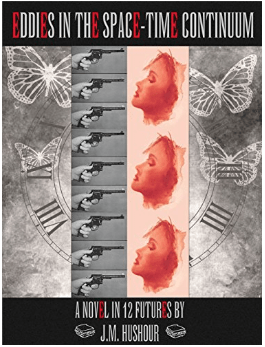
eddiesThe next book I’m reviewing here is Eddies in the Space-Time Continuum by J.M. Hushour, a thoroughly unconventional comedic sci-fi novel. This is going to be a longer review than the others, because there is a lot to say about this work. I downloaded the ebook over two years ago and discovered three things: one, the writing is phenomenal; two, the book does not exist in print; and three, the book would be over a thousand pages long if it did exist in print. I don’t enjoy reading ebooks as much as I enjoy reading print books (I know, it’s 2018, sue me) and this book’s improbable length added to that issue, but the writing was so good that I wasn’t willing to give up on it. So, I tried and retried this book a couple of times before I finally got a running start at it and spent a month reading through the whole darn thing. It was most definitely worth the read, but likewise reading it was a real chore.

The novel consists of twelve chapters. Each chapter (with one exception) takes place on March 30, 2050, the birthday of our protagonist, Eddie. As we gradually learn, Eddie has a condition similar to that of Bill Murray’s character in Groundhog Day or Tom Cruise’s character in Edge of Tomorrow. He is constantly reliving the same day. In this author’s interpretation of the theme, each repeated day that Eddie experiences is in a different version of the future. Humanity just keeps on finding new ways to make itself miserable, and Eddie is witness to every one of them. Doom by rising sea levels. Doom by corporatocracy. Doom by plague. There is always some monstrous crisis coming to a head on Eddie’s birthday.

In every version of the future, Eddie is a physically imposing but gentle-hearted creative type, fairly befuddled by his place and time. He owes some inspiration to Douglas Adam’s baffled protagonist Arthur Dent (and, the book’s title is itself a reference to The Hitchhiker’s Guide to the Galaxy). Eddie is inevitably and hopelessly in love with Viola, a Scottish woman who in every version of the future is some kind of outsider radical extremist, in her own mind fighting to free the world from its present crisis. Though their first meeting in the first version of the future was filled with quite a lot of hostility, every subsequent future brings them closer and closer together, with Eddie becoming braver and stronger in each repetition, and with cycles of déjà vu and shared recurring symbols—an enigmatic sandwich, the Shakespeare play Twelfth Night, butterflies—revealing to Eddie and Viola that they have met each other over and over again in different versions of their reality. Binding all of these realities together is the mystical notion of the qutb, something like the axis of a wheel, a notion taken from Islam and explored in this work. Also in each reality appear a cast of characters whose fates are bound with those of Eddie and Viola. To name a few key players: Hijack, Eddie’s sometimes-male-sometimes-female sibling who is a sort of drug dealer Willy Wonka; Aivia, a woman who is inevitably in the process of using science to change into a bird; Hélolard, sometimes a therapist, sometimes a cyborg stripper, sometimes a military commander, usually a mentor, always taking command over Eddie; and, crucially, the antagonist, a mysterious entity called the Queen of Hurts, who is always appearing to tear down reality. If I haven’t made this clear yet, it’s all a lot to take in.

One of the reasons this book impressed me from the very beginning was its intense, colorful use of language as a vehicle for ideas, delivering metaphors and zingers and philosophical notions in every sentence, keeping the scene interesting even when little was happening. It reminded me a lot of the books I’ve read by Tom Robbins (and, I saw that this author listed Tom Robbins as an influence). The book is very funny from the very beginning, funny in a Douglas Adam kind of way, but as it goes on and the nature of the book’s central threat becomes clearer, the tone becomes much more serious.  The change happens slowly, so much that you might not notice it happening unless you get a ways into the book and begin comparing one chapter to another. With all this business of multiple realities and multiple speculations about the future, sometimes the book got very confusing. There were times when the events on the page really didn’t make a lick of sense. But, I was so impressed by the work as a whole that this didn’t bother me at all.

Readers should be aware that this is a book for adults, with quite a lot of violence and sex and coarse language and coarse themes and so on. Some readers are put off by that. As for me, I was blown away. I really wish this book existed in print, because I want it on my shelf. I want to be able to flip through physical paper pages of it and enjoy it that way, because it is a masterpiece. I would highly recommend it to a wide variety of readers: fans of science fiction, fans of comedy, fans of absurdism and surrealism, readers looking for new and original ideas, etc. This book seems to be pretty obscure right now, but I don’t think it should be. I think a really wide audience would and should appreciate this book as much as I have.

And now, as I always do in these reviews, my bit of advertisement. If you are a fan of fantasy, you can look into my own book, Tales of Cynings Volume I, in print format here or Kindle format here.


New Book Review 37: Deep Space Accountant

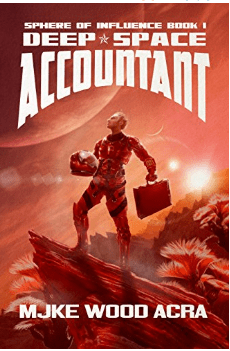
deep space accountantMy next indie book review is for the sci-fi novel Deep Space Accountant, by Mjke (yes, that’s the correct spelling) Wood, the first book in the Sphere of Influence series. This novel starts out with strong comedic overtones, but as it develops the story becomes closer more like a thriller. The novel is set in the 23rd century, in which humans have abandoned the scoured and polluted ruins of Earth and spread throughout the universe. The sum area of human habitation is known as the Sphere of Influence, but most of Earth’s biodiversity perished with Earth, including all trees and most animals. Lightspeed travel, teleportation, vat-grown meat, and a sentient AI companion called an imentor (using the pronouns Jim or Kim, depending on the gender of the user) are regular parts of life in the 23rd century.

The protagonist, the Deep Space Accountant in question, is Elton D. Philpotts, an everyman nobody sort of character who works a mediocre job as an ordinary ground-bound accountant but aspires to the lofty and glorious position of a deep space accountant. Not being an expert in Relativistic Accountancy (that is, assessing costs involved with lightspeed travel, the wear and tear on spaceships, and so forth), he is utterly unqualified and can only dream. It’s notable that since genetic modification of embryos is a regular part of the future, a botched attempt at making him a superior human left him with the ability to memorize any number he sees. This is useful for his job, but no replacement for Relativistic Accounting experience.

Despite his lack of qualifications, Elton lands an interview with Space Corps for a deep space accountant position, and despite the comical awfulness of the interview, he gets the job, boards a shuttle which promptly explodes, and finds himself fleeing for his life from a sinister corporation which had meant to use him as a scapegoat and pawn in their wicked schemes for…well, if you want to know what the schemes are you’ll have to read the book, because I’d hate to give further spoilers.

The writing is smooth, without the nagging little errors I’ve come to expect from so many indie novels. The humor does fade as the story progresses, but it’s good where it is. Elton, a mediocre accountant who is forced to be a hero, is an entertaining character. With his ticks and quirks and so on, I can imagine him being a character in a Wes Anderson film, which was endearing for me.  The secondary characters weren’t all quite as strong, some of them kind of blended together for me, but that’s not so bad. There is a romantic arc to the story which was a little improbable, but it’s a genre of improbable things, so that’s not so bad either. Elton really does have “plot armor”, consistently surviving shootings and crashes and explosions and so forth because the story needs him alive, but being a comedy, this sort of thing is expected. There was one weakness to the story, in my opinion. The main antagonist, a Space Corps bigwig named Martin Levinson, is a pretty clichéd character. He’s a bad guy in a business suit, driven by greed and sociopathy without any meaningful complexity behind him, and characters exactly like him have been oozing their way through the offices of sci-fi in various media for decades.

All in all, the story was a good one. I enjoyed it, and I’d recommend it for fans of comedy (specifically off-beat comedy) and sci-fi (including hard sci-fi, which we so rarely see). I’d especially recommend it for sci-fi fans who are looking for something fresh and different.

Now, once again, my bit of promo. If you are a fan of fantasy, you can look into my own book, Tales of Cynings Volume I, in print format here or Kindle format here.

New Book Review 36: Demorn: Soul Fighter

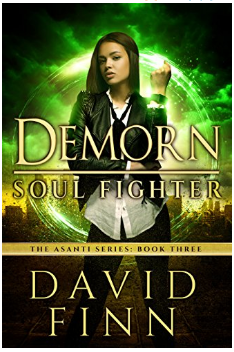
demorn 3The next indie book review I’m doing is for David Finn’s sci-fi fantasy space opera all-around actionfest, Demorn: Soul Fighter. This is the third book of the Demorn series, and I reviewed the first and second of them last year. Those reviews can be found here and here.

As a quick refresher on the premise, Demorn, the Wandering Princess of Swords, is a witty (and sometimes nihilistic) young woman who has time-travelled, space-travelled, and dimension-travelled throughout a multiverse that’s crumbling under the weight of imminent cosmic calamity. She is an extraordinary fighter, making use of guns, fists, a supernatural flaming katana, and a variety of magical objects gifted to her by gods and other entities in her wide and varied travels. She has been a priestess, arena fighter, and presently a mercenary. She also really loves comic books, and is good friends with Frank Sinatra, who happens to be a leader in a resistance against cosmic baddies.

Each of the Demorn books has had a common difficulty. In their freneticism and dimension-jumping and panache, they are confusing as hell. They’re all packed with action which is so well-written and so detailed that it’s a beauty to read, but keeping track of the plot is always challenging. In Soul Fighter, a catastrophe called the Fracture Event has torn apart the multiverse, erasing past timelines and sending beings from one dimension into another, wreaking all kinds of havoc. Members of a cultish organization called the Triton Corporation initiated the Fracture Event for diabolical purposes involving wicked cosmic gods (fans of H.P. Lovecraft will recognize the concept). Demorn starts in a Las Vegas-like metropolis called Bay City, where she competes in Soul Fight tournaments. Each fighter carries several mystical skulls which contain a soul, enabling them to fight and die multiple times. The loser of a fight has their soul-skulls taken away by a Death Banker, shadowing persons with their own motives and allegiances. From this setting, Demorn turns from gladiator to assassin to hunt down one Death Banker who means to release a cross-dimensional plague on the city. This sets her on a path to encounter an old friend and sometimes enemy, Iverson, an operative and detective-like character with whom she embarks on a quest to find the Reset Pyramid, which will enable them to reset time and avert the Fracture Event. Along the way they encounter former friends and rivals and lovers (Demorn, I nearly forgot to mention, is a lesbian), including Demorn’s brother Smile, her former co-priestess Toxis, her former lover Winter, the powerful warriors Wolf and Wrecking Ball, and the white-collar foes within the Triton Corporation. This book also has a brief appendix to help keep track of all the characters, factions, and magical items in the series.

I can’t stress enough that despite how confusing these books are, I love them. Each of them has been an incredibly fun read, and I’d highly recommend them for fans of sci-fi and fantasy.  Reflecting on the way the stories work, I see a lot of influence from comic books especially. With the variety of worlds and scenarios and the vivid descriptions, I’ve wondered if the books might be enriched if they were in fact graphic novels instead of prose novels. If the author ever does make a graphic novel of the series, I would be excited to read it, and I certainly look forward to the release of the fourth book in the series, titled Demorn: Ultimate Fate.

Now, once again, my bit of promo. If you are a fan of fantasy, you can look into my own book, Tales of Cynings Volume I, in print format here or Kindle format here.

New Book Review 35: Across the Realm: Life Always Finds A Way

Across the realm 1Again, I’ve gotten off track with these reviews, but again I’m trying to keep at it. This time, I’m reviewing Isobel Mitton’s novel Across the Realm: Life Always Finds A Way. This is the first of the space opera series ‘Across the Realm’, which includes a sequel titled Across the Realm: When Two Tribes Go to War.

When I was asked to read and review this book, I must admit to the cardinal sin of judging a book by its cover. The cover of the first edition looks unfortunately amateurish, and on the basis of that I assumed that I’d read the first twenty percent of this book and conclude that it wasn’t worth my time, as I’ve done for several other indie books. But, this book surprised me. The prose had some rocky points but overall was pretty good, there were relatively few editing errors, and the premise, while certainly out-there,  caught and kept my interest. It’s also noteworthy that more recent edition have a new and more professional cover, which I am including in this post.

The book is set in the year 2699. A cultural and physical divide has split the Earth into a northern “realm” and a southern “realm”, which have been at war for centuries. In the north humans live under strict racial segregation. Apart from space travel, they haven’t had a great many scientific breakthroughs since the 21st century, and their understanding of science, specifically biology, is distorted by their racial ideals. In the south, humans have radically altered into cybernetically enhanced telepathic superhumans who breathe argon and whose bodies are in some way composed of mystic energy. They are racially integrated and mixed, they live for centuries because disease has been eradicated, they have eliminated reproduction by growing embryos in tanks, and they worship their ancestors and Mother Earth, the source of their energy. Water is absolutely poisonous to them. A force field separates the north from the south and both sides seek to break through the force field and conquer the other side of it.

((((((((((((((((SPOILERS HERE IN THIS PARAGRAPH))))))))))))))))A convoluted Romeo-and-Juliet sort of situation develops between Greg, a man and high-ranking soldier from the north, and Naledi, a woman and elite warrior of the south when the two crash onto a planet together after a space battle. Prior to this Naledi received a vision in which she was instructed by her ancestors to restore the humanity of the South, which had deviated too far from natural humanity. Along with Greg and Naledi’s storyline, there are numerous other characters, fighters and spies and priestesses and scientists and so forth, all influencing the direction of the war. The book ends on a cliffhanger, with an enormous battle between the two sides about to begin.

As I said earlier, the premise is out there. Obviously the world and setting are not realistic. The science presented in the work is all nonsense, which we generally accept and overlook in space operas (midichlorians, anyone?). That being said, the story was so committed to its world and so detailed and specific in what it’s like and how it came to be that way that I couldn’t help but be impressed. Some of the character motivations were murky and strained credibility at times, but the main story arcs where engaging and intriguing, and I’m pleased to say that I quite enjoyed the book.

Fans of sci-fi and space opera and readers looking for something original and unique are likely to also enjoy this book.

Now, once again, my bit of promo. If you are a fan of fantasy, you can look into my own book, Tales of Cynings Volume I, in print format here or Kindle format here.

New Book Review 34: Shiva XIV

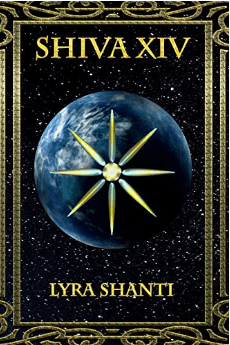
shiva xivThe next book review on this site is Lyra Shanti’s science fiction/space opera novel Shiva XIV, first of the Shiva XIV series, which currently includes three novels and one short story. The series is set in what seems to be a distant future, where humans have established civilizations on several different planets throughout the universe.

The protagonist of the novel is Ayn, the son of the queen of the planet Deius. All of the people on Deius follow a strict religious doctrine, and Ayn is declared at birth to be the fourteenth incarnation of Shiva (a god from real-world Hinduism, although I wasn’t sure if he is meant to be the same god in this novel) and the second incarnation of the spacefaring historical figure The Great Adin, and is consequently given the messianic title Bodanya. As the Bodanya, Ayn is expected to fulfill an ancient prophecy and lead his people into a new age by solving the Great Paradox, a sort of theological issue for the people of Deius. Ayn also happens to be born intersex, with both male and female genitalia. The story follows him from his time as an infant to his early adolescence.

In this future universe, there are ideological divisions among the planets between those who follow religious doctrines and those who strictly follow science. The planets Kri and Ohr are two planets whose people follow science, and as such they are sometime rivals and sometime allies of Deius. The novel’s plot gets going when a meeting of the leaders of these three planets meet, and anti-religious Deiusian extremists attempt to murder Ayn. Ayn escapes with the help of the Ohrian prince, Zin, and adventures and conflict ensue.

The novel’s premise is dynamite. When I started reading it, I immediately began comparing it with Frank Herbert’s Dune for its concept of how religion and cultural divides could continue to shape society even when humanity expands beyond the constraints of our solar system. The beginning of the novel, in my opinion, was its strongest point. Later on though, I thought the novel weakened in some ways. One of Ayn’s mentors is a priest named Pei, and after Ayn and Zin leave Deius he has both a romantic arc and a warrior-training arc, and neither story arc seemed very believable to me based on what the character is like. The friendship between Ayn and Zin also stretched credibility for me. Some aspects of the prose irked as well, specifically use of exclamation points from a third-person omniscient narrator.

But, the novel had its strengths as well. The various settings and otherworldly cultural aspects were described quite well, and with its twists and intrigues and surprises, I wasn’t ever bored with the story. There’s a lot of potential here, not all of which was realized in the first book (which, if I’m not mistaken, was the author’s debut novel), and that gives me hope that the others in the series may expand the novel’s universe and achieve more of its potential while avoiding some of the pitfalls that this novel fell into. With that in mind, I think I will most likely continue with the series and read its second book, The Veil of Truth.

Now, once again, my bit of promo. If you are a fan of fantasy, you can look into my own book, Tales of Cynings Volume I, in print format here or Kindle format here.

New Book Review 31: Rise of the Europan

europanThe next book I’m reviewing is Rise of the Europan, a collaborative science fiction work led by Joel Stottlemire. The book’s central premise is that in a future where humans have established colonies on other worlds in the solar system and elsewhere in the galaxy, settlers on Europa, the ice moon of Jupiter, have awakened a god-like entity (Genabyel) who begins a campaign of destruction against humanity. The book contains interrelated stories by six different authors chronicling the events of this war, on different worlds and from the perspectives of different people and from Genabyel himself.

Using multiple authors to tell various parts of one story is an ambitious project, and I laud these authors for taking it on. The project brings to mind the Star Wars expanded universe novels (the Thrawn trilogy, the New Jedi Order series, etc.) which I consumed and loved as a teenager. It gives a sense of size and scale to the narrative, even when the characters of the different stories don’t interact with one another. The continuity and connectivity of it, the fact that in spite of the distance between stories it maintains cohesion, is admirable.

Of course, the fact that the stories uses different viewpoints in different locations means that the novel-length book does not follow a consistent set of characters, but instead several characters with short character arcs. The only character who appears in each of the stories is Genabyel himself, about whose personality and attributes we learn more and more as the book progresses. Genabyel has some Lovecraftian attributes about him. He comes from a home deep beneath a strange ocean, he claims to have travelled through other dimensions and made contact with various divine beings, and he looks on humans in the same way that a human might look on cockroaches: troublesome creatures to be crushed. He thinks of destroying humans as a divine mission, and uses language reminiscent of the Bible in his musings about them. I liked Genabyel as a character; at first I thought he might be just a Cthulhu knock-off, but as the story progressed I appreciated how well-developed he was. The human characters that appeared throughout the stories were, as far as I recall, adequately developed as well. There are soldiers, politicians, scientists, and generally diverse cast all reacting to the crisis of the Europan in various ways, some heroic and some cowardly. We don’t get to spend a lot of time with these characters, but the time we get is enjoyable.

The war against the Europan, however, is completely hopeless. He is undefeatable, and this kid of has the effect of making the genre here seem a variant of apocalyptic fiction. It’s about the human characters reacting to the end of their world, that is to say the end of their world-spanning human civilization. The sequences of destruction, happening in their various ways and various places, are very detailed, and generally I liked the way the book was written. There was one significant problem, a surprising one given the otherwise high quality of the book. There were tons of typos, tons of misused apostrophes and spelling errors and use of incorrect words. The problem was throughout the book, not just in the stories of one or two of the authors. A bit more proofreading  would have easily solved the problem.

Now, once again, my bit of promo. If you are a fan of fantasy, you can look into my own book, Tales of Cynings Volume I, in print format here or Kindle format here.
New Book Review 29: SciFan Magazine January 2017

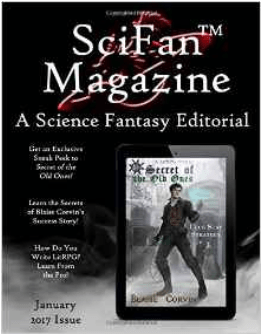
scifanThe next book review I’m doing is a little different than the previous ones. I’m reviewing the January 2017 edition of SciFan Magazine, a monthly digital magazine designed to showcase current and upcoming independent authors. The editor is Richard M. Mulder, whose work I hope to review at a later date. There were thirteen stories/excerpts in the magazine, and I will address each of them here.
The first, ‘Octov’s Rise to Ainoren’ by Dawn Chapman, is an excerpt from the novel The Secret King: Lethao, which I reviewed on this blog here. Chapman’s work is excellently written, with strong detail and description and otherworldly characters who are familiar enough for the reader to empathize, yet whose otherworldly attributes and powers create a sense of wonder while reading.  This particular excerpt is full of action and intrigue, and I liked it.

The second, ‘Séance on Death Row’ by Douglas Kolacki, is a short horror story in which a group of people, including a murderer, hold a séance to speak with the murderer’s victim. It was an older style of horror, relying heavily on implication and imagination, with dread permeating the story and with the horror stemming from forces beyond the grave which may be seen but not fully understood. It reminded me of Edgar Alan Poe’s work. I liked it.

The third, ‘The Tot of Wonder’ by John Taloni, is a much more lighthearted and goofy tale of a superhero father who lives with his non-super wife and his super-powered toddler son.  There’s not a whole lot to it, but I think it’s geared more toward a young audience. It felt a little out of place in this magazine, but as a work for children I suppose it’s fine.

The fourth, ‘Miss Soames’ by Kyle Hemmings, was an odd one. I can’t say much about it without completely spoiling the story, but I didn’t like it very much. The prose was okay, but the plot was kind of nonsensical, a sort of bait-and-switch horror story that was so busy trying to surprise the reader that it forgot to be scary.

The fifth, ‘Orlok’s Song’ by David Castlewitz, was my favorite in the magazine. In this short story, there is a sentient species called the Peet (animal-like beings) who have been driven from their forest homes by human enterprise. Orlok is the father of a family that tries to survive in the new concrete forest of city slums. The writing in it was beautiful, and the story was brief but excellent in its narrative and conclusion. I’d definitely recommend this one.

The sixth, ‘Voices Beneath the Ice’ by Matthew McKiernan, is a sci-fi story with horror elements involving a trio of astronauts who land on Europa (a moon of Jupiter) and begin to find strange reasons to hate each other. I liked the concept a lot, but some of the prose needed work. I think this story has a lot of potential, and could be really great if some more time was given to it.

The seventh in the magazine is an excerpt from the book Secret of the Old Ones by Blaise Corvin. Its genre is given as LitRPG Sci-Fan™, in which the real world and the world of gaming are both important to the narrative. The only issue I have with the excerpt is that the character never seemed to really be in danger, but since it’s just an excerpt of a larger work, I’m sure there will be more conflict and excitement later in the story. I really liked this excerpt, and I’ll probably read the book at some point.

The eight is also an excerpt, titled ‘The Stirring’ by Jaren Fleming. It was something like Christian creationist science fiction, about a planet that serves God (here called The Father) at war with gooey alien beings that serve Satan. The whole excerpt was nothing but combat, and the writing was good, but  I hope there is character development and more fleshing-out of the story in the larger work. I wasn’t a huge fan of the premise, but I can imagine other people liking it quite a lot.

The ninth was ‘Stormguard: The Invisible War’ by Tom Fallwell. It was another case of Christian-themed action sci-fi. I can’t say much about it without spoiling the whole story, but it starts with a man waking up in a crater with no memory of who he is or where he came from. The writing was okay, but I thought the premise was kind of a cliché. This was an excerpt of a larger work as well, but I probably won’t seek out the larger work.

The tenth, ‘Spacejacking’ by Russell Hemmell, seems like it may be an excerpt from a larger work, but it was unclear to me. It’s a futuristic tale of an alien abduction during space exploration, and the subsequent consequences. Again, I can’t say a lot without giving away the entire story, but I liked this one. It had some interesting and unusual ideas in it, and if it is part of a larger work I’d like to see where the story goes.

The eleventh story, ‘The Brat and the Other Country’ by David Perlmutter, was a real oddball. The premise was similar to the film ‘Who Framed Roger Rabbit?’, if that film was a story about superheroes rather than a detective story. In the story, the cartoon characters of Earth actually live on another planet, and the main character is a superhero human who works alongside superhero cartoon characters. I can imagine other people really loving the premise, but it was just a bit too much of a stretch for me.

The twelfth story, ‘In the Hot Mists’ by John A. Frochio, is a steampunk tale about an airship race in which one airship has an unfair advantage because it’s crewed by extraterrestrials. Strange as this premise is, I liked it. The writing was good, it put a new spin on a familiar story, and I think lots of other people would enjoy the story too.

The last story (good job for sticking with me this long!) is ‘The Keystone Islands: Portals of the Grave’ by Lander Allen. It’s the first three chapters of a larger work, a soft sci-fi work set in a universe where Earth is a cultural center resented by the other planets. The tetrapath infection turning its victims into horrific monsters, and the protagonists have come from who-knows-where and are trying to figure out their past in the midst of this plague. It’s well-written and very intriguing, and I’d like to see where the story goes.

So, those are the thirteen stories from the January 2017 edition. I expect to review later editions of the magazine in this blog as well, as it seems like a great way to see at a glance what’s going on in the indie fantasy and sci-fi community.

Now, once again, my bit of promo. If you are a fan of fantasy, you can look into my own book, Tales of Cynings Volume I, in print format here or Kindle format here.

New Book Review 27: Atomic Underworld: Part Two

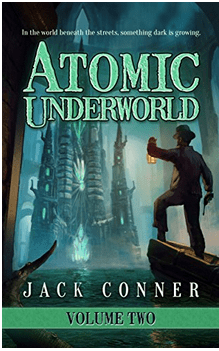
atomic-underworld-2-coverThe twenty-seventh book I’m reviewing here is Atomic Underworld: Volume Two, by Jack Conner. This book is the sequel to one I reviewed a few months ago, Atomic Underworld: Part One. That review may be read here. Within the same world this author also has the Atomic Sea series and the books Nightmare City and City of Shadows.

A quick recap of the setting: the story takes place in and around the subterranean city of Muscud, which sits over the highly toxic Atomic Sea. In this alternate world technology has developed in a steampunk-like direction, and humans share the city with various pre-human alien species and with humans afflicted by the mutating effects of the sea. Rival gangs hold the most power in the city, but power also belongs to the cultists who worship various otherworldly gods. In the last book, our hero Tavlin “Two-Bit” Metzler, a gambler and thief and all-around rogue, was captured by cultists and brought to the temple of their god, Magoth. This second part to the story begins with Tavlin’s captivity and brainwashing in their temple. Other characters working with and against Tavlin include his ex-wife Sofia, friend and brutal mob boss Vassas, rival mob boss and cultist Havictus, the cult leader known only as the Lady, and a ghostly woman of ambiguous allegiance named Millicent.

As noted in the review of the previous book, the strongest feature of these books (probably of all Conner’s work) is the detail. The stinking, toxic, moist underworld that he paints feels stinky and toxic and moist. The description is vivid and graphic, and I really appreciated that. The characters are in some ways a little cookie-cutter (Boss Vassas is every cigar-chomping mob boss ever, Tavlin is right out of the Han Solo/Jack Sparrow/Malcolm Reynolds school for likable outlaws, all of the gangsters are noir characters with superficial mutations), but they’re fun anyway. Now, as I said, I read the previous book a few months ago, so I generally remembered who the characters are, good guys and bad guys and whatnot, but I couldn’t really remember which slimy jiggly pre-human alien race was which, and the sequel didn’t really take any time to recap those details. The story goes straight forward where the last book ended, with no recaps at all. For this reason, I wonder why the two books are in separate volumes at all. I’m aware that the author also released an Omnibus Edition with both books included, but why not just have them together as one novel? I can guess, but I prefer not to be cynical and to instead hope that the reason was creative.

For anyone who wishes to read these stories, the genre needs to be well understood. These are pulpy action stories. They take some inspiration from the horror tales of H.P. Lovecraft, but they are not horror. The purpose of these stories is to entertain, and in that capacity they deliver. A small advisory warning: the book contains a lot of graphic violence, some references to rape, and one descriptive sex scene. Some more sensitive readers might be put off by these features, though I personally was not. I found both of these books fully entertaining, and I expect if I read other work by this author I will encounter the same. The conclusion especially, the climactic fight scene that resolved the story, was especially satisfying. Fans of action and crime stories, dark fantasy, and horror/pulp fiction are the recommended audience for these books. As a fan of science fiction and fantasy, I loved them.

Now, once again, my bit of promo. If you are a fan of fantasy, you can look into my own book, Tales of Cynings Volume I, in print format here or Kindle format here.

This post was originally featured on cwbookclub.com.

New Book Review 23: Cthulhu Armageddon

cthThe twenty-third book I’m reviewing on this blog is Cthulhu Armageddon by C.T. Phipps. It’s billed as a post-apocalyptic western, but I’d say calling it a western is a stretch. It’s a fantasy action thriller set in a desert wasteland, conceptually closer to a story like Mad Max than a story like The Good, the Bad, and the Ugly.
To really have context for this novel, you need at least a cursory knowledge of the works of H.P. Lovecraft, whose popular stories include The Call of Cthulhu, The Dunwich Horror, and my personal favorite The Case of Charles Dexter Ward. Lovecraft stories and mythos contain the idea that in the sea, underground, and in the far reaches of space are monstrous alien gods who will someday return to power and destroy humanity. Cthulhu Armageddon is a post-apocalyptic action novel based around the idea that in the future, Lovecraft’s gods and monsters (his specific gods and monsters, here with the same names and aspects that they have in Lovecraft’s works) have risen and wreaked havoc upon the earth. Their ravages have turned the world into a hellish place, where the surviving “civilized” humans fight for survival alongside rabid cultists, mutant monsters, and the terrible gods themselves.

Our protagonist, John Henry Booth, is one of the surviving humans in a group called the Remnant.  He is a trained and tenacious soldier who struggles through shaky alliances and bitter enmities with monsters and humans in his quest for revenge against the mad wizard Doctor Alan Ward, a former scientist who believes the only way to survive with the gods is to become as monstrous as them. By his side throughout the story is his mutant friend Richard, cultist and former lover Katryn, his teammate Jessica, a professional torturer named Mercury, and a wide-eyed little girl named Jackie who’s seen entirely too much brutality for her age.

This isn’t the first brutish post-apocalyptic novel I’ve reviewed on this blog, but within that genre I think this is the best one. The premise may sound schlocky, a little too close to fan-fic perhaps (not that there’s anything wrong with that, but it does have a poor reputation), but the quality of the writing here is impressive. For the most part it’s smooth, well-paced, and strikingly professional. Especially excellent were the book’s action scenes, of which there were many. These were simply incredible. Some of the characters were a little clichéd, a little stereotyped post-apocalyptic warrior, but the central characters had a lot of depth and wisdom to them, much more than you would expect in an action adventure like this.

There are a few places in the book where a sentence was confusingly structured or where the wrong word was used (‘grizzly’ when the author meant ‘grisly’, for example), but these were rare and the book’s strength far outweigh this small weakness. It is also worth noting that while this book takes ideas and personages from Lovecraft, it is not meant to be modeled on Lovecraft’s work. In Lovecraft, the atmosphere is full of dread and existential horror, carried forward and permeating the narrative through the terror, disgust, or madness of the characters. The characters in Cthulhu Armageddon do have terror and disgust and madness, but they also have humor and love and jealousy and anger.  They crack wise while they crack skulls, and frequently they spit in the face of death as opposed to cowering like a Lovecraft character would. This isn’t a horror novel. It’s an action adventure fantasy novel, and it’s a thoroughly enjoyable one.

For potential readers, it is worth noting that the book has profanity and sex and (if this post hasn’t already made it clear) lots and lots of pulpy violence, so it’s not recommended to sensitive readers. I got a lot of fun out of it, and can definitely recommend it to fans of action, sci-fi, and especially the weird tales of H.P. Lovecraft.

Now as always, my bit of promo. If you liked this book review, you can see my others here: New Book Review 1New Book Review 2New Book Review 3New Book Review 4New Book Review 5New Book Review 6New Book Review 7New Book Review 8New Book Review 9New Book Review 10New Book Review 11New Book Review 12New Book Review 13New Book Review 14New Book Review 15New Book Review 16New Book Review 17New Book Review 18New Book Review 19New Book Review 20New Book Review 21-New Book Review 22

If you are a fan of fantasy, you can look into my own book, Tales of Cynings Volume I, in print format here or Kindle format here.

This post was originally featured on cwbookclub.com.

New Book Review 22: Stupid Humans

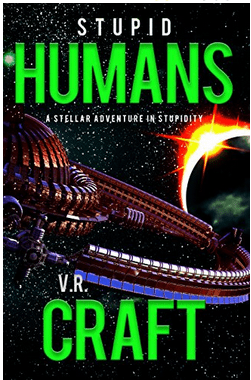
stupid-humans-coverThe next indie novel I’m reviewing here is Stupid Humans, by Vivian Cummings (using the pen name V.R. Craft). This is primarily a science fiction novel with strong overtones of satire and social critique.  The setting is sometime hundreds or thousands of years in the future, on a space station on the opposite side of a wormhole that has opened hear Earth. Despite the exotic location, the author carefully and cleverly included many familiar aspect of the real and present world, with a focus on the more obnoxious and, well, stupid aspects.

In this book’s backstory, the most intelligent humans on Earth fled the planet millennia ago in an event the rest of the world knew as the sinking of Atlantis. They established a spacefaring civilization and named themselves the People, in contrast to the stupid Humans who they left behind on Earth. The passage of time led to somewhat divergent evolution between the People and the Humans (for example, the People developed tails), and the People saw themselves as in every way superior to the Humans they’d left behind. The novel kicks off some years after a wormhole opens between Earth and the space station Five Alpha, where several thousand People live. The unexpected first contact leads to distrust, fear, political wrangling, business opportunities, and a war which the People’s public relations officials struggle to avoid calling a war. In this conflict we have doctors and politicians and beer moguls and regular Joes of both the Humans and the People all trying to find an unlikely stability.

The writing is very good, the pacing was good, and I thought the story overall was very clever and original. It had many familiar elements to it (in some ways it seemed to take the concept behind the movie Idiocracy and invert the premise) but was very fresh as an independent sci-fi work. There were some small typos throughout the story, but they weren’t concentrated anywhere and they weren’t enough to be distracting. The characters were complex, the dialogue and interactions were quite believable, and there were several legitimately funny bits of comedy throughout the novel.

There was one area where the book had some weakness though. It had quite a lot of characters who were difficult to keep track of, and the character who fell into the protagonist’s role is deliberately mysterious about her motives and backstory. I’m referring to Samantha, a Human bartender and reporter who ends up on Five Alpha and is subject to scrutiny by People who are suspicious of her desire to stay on the station. The question of her motive isn’t answered until the very end of the book, and this crucial aspect of Samantha’s personality prevents the reader from developing a very strong connection with the character.

That being said, Stupid Humans  is an intelligent and high-quality work of science fiction, a caliber above many other sci-fi novels that I’ve read. I would definitely recommend it to fans of the genre, and to fans of humor and satire.

Now as always, my bit of promo. If you liked this book review, you can see my others here: New Book Review 1New Book Review 2New Book Review 3New Book Review 4New Book Review 5New Book Review 6New Book Review 7New Book Review 8New Book Review 9New Book Review 10New Book Review 11New Book Review 12New Book Review 13New Book Review 14New Book Review 15New Book Review 16New Book Review 17New Book Review 18New Book Review 19New Book Review 20New Book Review 21

If you are a fan of fantasy, you can look into my own book, Tales of Cynings Volume I, in print format here or Kindle format here.

This post was originally featured on cwbookclub.com.