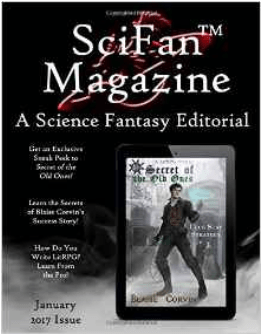
New Book Review 29: SciFan Magazine January 2017

scifanThe next book review I’m doing is a little different than the previous ones. I’m reviewing the January 2017 edition of SciFan Magazine, a monthly digital magazine designed to showcase current and upcoming independent authors. The editor is Richard M. Mulder, whose work I hope to review at a later date. There were thirteen stories/excerpts in the magazine, and I will address each of them here.

The first, ‘Octov’s Rise to Ainoren’ by Dawn Chapman, is an excerpt from the novel The Secret King: Lethao, which I reviewed on this blog here. Chapman’s work is excellently written, with strong detail and description and otherworldly characters who are familiar enough for the reader to empathize, yet whose otherworldly attributes and powers create a sense of wonder while reading.  This particular excerpt is full of action and intrigue, and I liked it.

The second, ‘Séance on Death Row’ by Douglas Kolacki, is a short horror story in which a group of people, including a murderer, hold a séance to speak with the murderer’s victim. It was an older style of horror, relying heavily on implication and imagination, with dread permeating the story and with the horror stemming from forces beyond the grave which may be seen but not fully understood. It reminded me of Edgar Alan Poe’s work. I liked it.

The third, ‘The Tot of Wonder’ by John Taloni, is a much more lighthearted and goofy tale of a superhero father who lives with his non-super wife and his super-powered toddler son.  There’s not a whole lot to it, but I think it’s geared more toward a young audience. It felt a little out of place in this magazine, but as a work for children I suppose it’s fine.

The fourth, ‘Miss Soames’ by Kyle Hemmings, was an odd one. I can’t say much about it without completely spoiling the story, but I didn’t like it very much. The prose was okay, but the plot was kind of nonsensical, a sort of bait-and-switch horror story that was so busy trying to surprise the reader that it forgot to be scary.

The fifth, ‘Orlok’s Song’ by David Castlewitz, was my favorite in the magazine. In this short story, there is a sentient species called the Peet (animal-like beings) who have been driven from their forest homes by human enterprise. Orlok is the father of a family that tries to survive in the new concrete forest of city slums. The writing in it was beautiful, and the story was brief but excellent in its narrative and conclusion. I’d definitely recommend this one.

The sixth, ‘Voices Beneath the Ice’ by Matthew McKiernan, is a sci-fi story with horror elements involving a trio of astronauts who land on Europa (a moon of Jupiter) and begin to find strange reasons to hate each other. I liked the concept a lot, but some of the prose needed work. I think this story has a lot of potential, and could be really great if some more time was given to it.

The seventh in the magazine is an excerpt from the book Secret of the Old Ones by Blaise Corvin. Its genre is given as LitRPG Sci-Fan™, in which the real world and the world of gaming are both important to the narrative. The only issue I have with the excerpt is that the character never seemed to really be in danger, but since it’s just an excerpt of a larger work, I’m sure there will be more conflict and excitement later in the story. I really liked this excerpt, and I’ll probably read the book at some point.

The eight is also an excerpt, titled ‘The Stirring’ by Jaren Fleming. It was something like Christian creationist science fiction, about a planet that serves God (here called The Father) at war with gooey alien beings that serve Satan. The whole excerpt was nothing but combat, and the writing was good, but  I hope there is character development and more fleshing-out of the story in the larger work. I wasn’t a huge fan of the premise, but I can imagine other people liking it quite a lot.

The ninth was ‘Stormguard: The Invisible War’ by Tom Fallwell. It was another case of Christian-themed action sci-fi. I can’t say much about it without spoiling the whole story, but it starts with a man waking up in a crater with no memory of who he is or where he came from. The writing was okay, but I thought the premise was kind of a cliché. This was an excerpt of a larger work as well, but I probably won’t seek out the larger work.

The tenth, ‘Spacejacking’ by Russell Hemmell, seems like it may be an excerpt from a larger work, but it was unclear to me. It’s a futuristic tale of an alien abduction during space exploration, and the subsequent consequences. Again, I can’t say a lot without giving away the entire story, but I liked this one. It had some interesting and unusual ideas in it, and if it is part of a larger work I’d like to see where the story goes.

The eleventh story, ‘The Brat and the Other Country’ by David Perlmutter, was a real oddball. The premise was similar to the film ‘Who Framed Roger Rabbit?’, if that film was a story about superheroes rather than a detective story. In the story, the cartoon characters of Earth actually live on another planet, and the main character is a superhero human who works alongside superhero cartoon characters. I can imagine other people really loving the premise, but it was just a bit too much of a stretch for me.

The twelfth story, ‘In the Hot Mists’ by John A. Frochio, is a steampunk tale about an airship race in which one airship has an unfair advantage because it’s crewed by extraterrestrials. Strange as this premise is, I liked it. The writing was good, it put a new spin on a familiar story, and I think lots of other people would enjoy the story too.

The last story (good job for sticking with me this long!) is ‘The Keystone Islands: Portals of the Grave’ by Lander Allen. It’s the first three chapters of a larger work, a soft sci-fi work set in a universe where Earth is a cultural center resented by the other planets. The tetrapath infection turning its victims into horrific monsters, and the protagonists have come from who-knows-where and are trying to figure out their past in the midst of this plague. It’s well-written and very intriguing, and I’d like to see where the story goes.

So, those are the thirteen stories from the January 2017 edition. I expect to review later editions of the magazine in this blog as well, as it seems like a great way to see at a glance what’s going on in the indie fantasy and sci-fi community.

Now, once again, my bit of promo. If you are a fan of fantasy, you can look into my own book, Tales of Cynings Volume I, in print format here or Kindle format here.
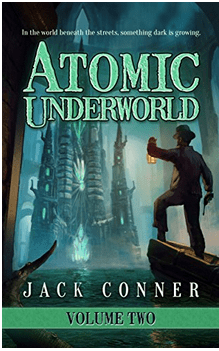
New Book Review 27: Atomic Underworld: Part Two

atomic-underworld-2-coverThe twenty-seventh book I’m reviewing here is Atomic Underworld: Volume Two, by Jack Conner. This book is the sequel to one I reviewed a few months ago, Atomic Underworld: Part One. That review may be read here. Within the same world this author also has the Atomic Sea series and the books Nightmare City and City of Shadows.

A quick recap of the setting: the story takes place in and around the subterranean city of Muscud, which sits over the highly toxic Atomic Sea. In this alternate world technology has developed in a steampunk-like direction, and humans share the city with various pre-human alien species and with humans afflicted by the mutating effects of the sea. Rival gangs hold the most power in the city, but power also belongs to the cultists who worship various otherworldly gods. In the last book, our hero Tavlin “Two-Bit” Metzler, a gambler and thief and all-around rogue, was captured by cultists and brought to the temple of their god, Magoth. This second part to the story begins with Tavlin’s captivity and brainwashing in their temple. Other characters working with and against Tavlin include his ex-wife Sofia, friend and brutal mob boss Vassas, rival mob boss and cultist Havictus, the cult leader known only as the Lady, and a ghostly woman of ambiguous allegiance named Millicent.

As noted in the review of the previous book, the strongest feature of these books (probably of all Conner’s work) is the detail. The stinking, toxic, moist underworld that he paints feels stinky and toxic and moist. The description is vivid and graphic, and I really appreciated that. The characters are in some ways a little cookie-cutter (Boss Vassas is every cigar-chomping mob boss ever, Tavlin is right out of the Han Solo/Jack Sparrow/Malcolm Reynolds school for likable outlaws, all of the gangsters are noir characters with superficial mutations), but they’re fun anyway. Now, as I said, I read the previous book a few months ago, so I generally remembered who the characters are, good guys and bad guys and whatnot, but I couldn’t really remember which slimy jiggly pre-human alien race was which, and the sequel didn’t really take any time to recap those details. The story goes straight forward where the last book ended, with no recaps at all. For this reason, I wonder why the two books are in separate volumes at all. I’m aware that the author also released an Omnibus Edition with both books included, but why not just have them together as one novel? I can guess, but I prefer not to be cynical and to instead hope that the reason was creative.

For anyone who wishes to read these stories, the genre needs to be well understood. These are pulpy action stories. They take some inspiration from the horror tales of H.P. Lovecraft, but they are not horror. The purpose of these stories is to entertain, and in that capacity they deliver. A small advisory warning: the book contains a lot of graphic violence, some references to rape, and one descriptive sex scene. Some more sensitive readers might be put off by these features, though I personally was not. I found both of these books fully entertaining, and I expect if I read other work by this author I will encounter the same. The conclusion especially, the climactic fight scene that resolved the story, was especially satisfying. Fans of action and crime stories, dark fantasy, and horror/pulp fiction are the recommended audience for these books. As a fan of science fiction and fantasy, I loved them.

Now, once again, my bit of promo. If you are a fan of fantasy, you can look into my own book, Tales of Cynings Volume I, in print format here or Kindle format here.

This post was originally featured on cwbookclub.com.

New Book Review 16: Atomic Underworld: Part One

The sixteenth book I’m reviewing is Atomic Underworld: Part One by Jack Conner, the first of the ‘Atomic Underworld’ duology, which itself is a prequel to Jack Conner’s ‘Atomic Sea’ series. The book is billed as Lovecraftian steampunk fantasy, which is to say that it takes inspiration from the otherworldly horror stories of H.P. Lovecraft and the speculative alternative history of steampunk sci-fi. In its execution I would also add ‘noir’ or ‘mystery’ to the genre. It’s a good mix, and the various pieces work well together.

The story’s protagonist is Tavlin ‘Two-Bit’ Metzler, a professional gambler and general rouge living in the subterranean city of Muscud, on the banks of the Atomic Sea. This city is one of several underground cities primarily inhabited by mutated humans, but also inhabited by ordinary uninfected humans, mutated animals, and members of various sentient pre-human species (some rather slug-like, some blob-like, and some arthropod-like). These cities are in the sewers of the larger metropolises above ground, and their primary authorities are multiple religious cults and various rival gangs. When Tavlin’s old friend and full-time mob boss Vassas has several members of his gang die under strange circumstances, Tavlin is asked to investigate. His investigations put him in the middle of a dangerous adventure centering on a strange weapon which the cults and sentient pre-humans are all desperate to get their hands (or tentacles) on.

The best thing about this book was its incredible level of description and texture. Muscud and the cities near it are disgusting places. They’re slimy, they stink, everything is damp and crawling and infected, and the descriptions are written with skin-crawling vividness. All of the mutant creatures, all of the alien-like underworld denizens, were described excellently. The quality of the writing was also very good, with few errors. I did feel like the characters drew heavily from crime-drama clichés, but that’s not so terrible. These kinds of characters are used because they’re effective. Maybe we’ve all seen movies with some fedora-wearing cigar-chomping pistol-waving mob boss shouting profanities before, but that doesn’t diminish the character’s entertainment value.

The book was heavy on action, with chases and gunfights familiar to anyone who’s read or watched any kind of mystery or crime dramas. The difference of course is that these fights are here taking place in a slimy underground city, which allows for some different approaches. The fights were well-written as well, however due to the way the story uses them, I would dispute the book’s Lovecraftian label. In a Lovecraft story, there is always a sort of creeping dread pervading the narrative. The characters in a Lovecraft story are victims of hellish otherworldly forces gradually driving them into unspeakable terror and insanity through the influence of eldritch alien gods. In Atomic Underworld, there are (or at least seem to be) eldritch alien gods , and there is dread, but the dread doesn’t pervade the narrative. The book doesn’t feel like a horror story. With a cocky rogue for a protagonist and with mobsters out of a 1940s noir film chasing each other through an urban jungle, the book feels more like action/adventure than it does horror. This isn’t a bad thing, but it is worth noting. It’s also worth noting that this book ends on a complete cliffhanger, which may annoy some readers.

On the whole, I enjoyed it. The detail was impressive and the story was engaging, and the odds are good that I’ll buy and read the second part of it.

And now once again, the plug. If you liked this book review, you can see my others here: New Book Review 1New Book Review 2New Book Review 3New Book Review 4New Book Review 5New Book Review 6New Book Review 7New Book Review 8New Book Review 9New Book Review 10New Book Review 11New Book Review 12New Book Review 13New Book Review 14New Book Review 15

If you are a fan of fantasy, you can look into my own book, Tales of Cynings Volume I, in print format here or Kindle format here.